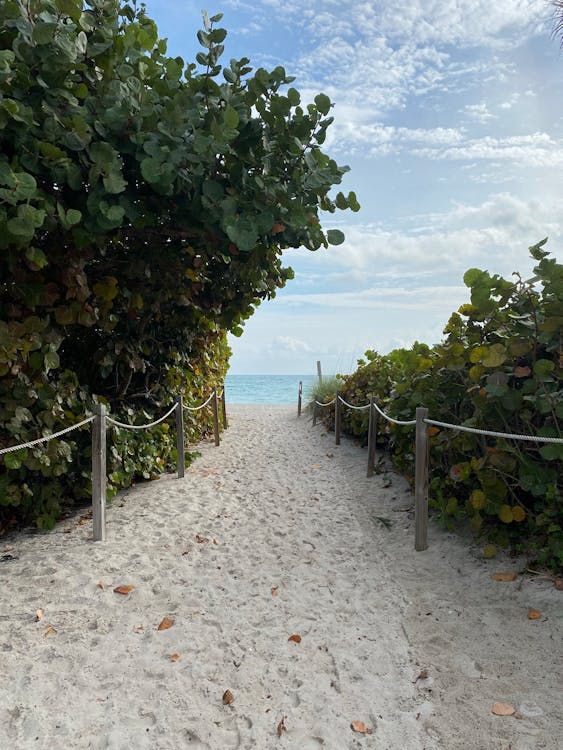
When I first arrived in Eruv Miami Beach, the golden light of sunset was washing over the Art Deco facades and palm-lined streets. It’s easy to fall in love with this city’s tropical rhythm — turquoise water, pastel hotels, and the hum of languages from all over the world. Yet, beyond the nightlife and beaches, I discovered a quieter, deeper rhythm that has pulsed here for generations — the rhythm of Jewish life and faith.
Walking down Collins Avenue on a Friday evening, I noticed families heading to synagogue, children laughing, and the soft glow of candles through windows. That’s when a question I’d heard before echoed in my mind:
“Is there an eruv in Miami Beach?”
The answer, as I soon learned, is yes — and not just any eruv. The Miami Beach Eruv is one of the largest and most meticulously maintained eruvim in the United States, stretching across much of the city and serving as a bridge between tradition and modern life.
Over the course of my visit, I discovered how this seemingly invisible boundary quietly shapes everyday life for thousands of Jewish families — helping them celebrate Shabbat, carry what they need, and stay connected without compromising faith.
In this guide, I’ll share everything you need to know about the Eruv of Miami Beach — its meaning, function, and spiritual importance — and how it turns this coastal paradise into a true community of faith and belonging.

Table of Contents
What Is an Eruv and Why It Matters
An eruv (plural: eruvim) is a symbolic boundary, defined by Jewish law (halacha), that transforms public areas into a shared private space for Shabbat observance.
Traditionally, carrying objects in public on Shabbat (the Sabbath) is not permitted — whether it’s house keys, prayer books, or pushing a baby stroller. The eruv extends the boundaries of home, allowing observant Jews to carry what they need while remaining faithful to halachic law.
This ancient practice connects cities across time and geography — from Jerusalem and Brooklyn to Paris, London, and now, Miami Beach.
The Eruv Miami Beach stands as a modern expression of this age-old principle — a boundary you can’t see but can feel in the way it strengthens community life. It’s a quiet thread that links homes, synagogues, and streets into a shared space of faith and togetherness.
The Spiritual and Practical Importance of the Eruv
For many families I met, the Miami Beach eruv is far more than a legal enclosure — it’s a lifeline that keeps community, joy, and accessibility alive.
Without an eruv, parents couldn’t push a stroller to Shabbat services, or carry a diaper bag, or bring food to a neighbor’s meal. On an island built for walking, that would mean isolation on the very day meant for connection.
But within the eruv’s boundaries, everything changes. The eruv Miami Beach allows for simple acts of daily life — walking with loved ones, bringing a prayer book, or visiting friends — while honoring the sacred laws of Shabbat.
It’s what transforms Miami Beach from just another beach city into a living spiritual home. The waves may frame the horizon, but the eruv frames the heart of Jewish life here — inclusive, enduring, and filled with quiet strength.
History of the Eruv in Miami Beach – A Story of Faith and Community Vision
When I began researching the Eruv of Miami Beach, I was struck by how deeply it reflects the evolution of Jewish life on this island. The story begins in the mid-20th century, when Jewish families and retirees started moving south from New York and New Jersey in search of sunshine, safety, and spiritual connection.
By the 1950s and 1960s, Miami Beach’s Jewish community had blossomed — synagogues multiplied, kosher bakeries filled the air with the scent of challah, and Shabbat dinners brought neighbors together under the palm trees. Yet one challenge remained: how could observant families maintain full Shabbat observance in a city designed for open streets and public beaches?
The answer came through faith, collaboration, and remarkable civic cooperation. Rabbis, community leaders, and municipal engineers worked hand-in-hand to design one of the first large-scale coastal eruvim in America — a boundary that would make it possible for families to carry items on Shabbat without breaking halachic law.
When I visited the area near 41st Street, often called “the heart of Jewish Miami Beach,” I saw the subtle signs of that original vision — wires glinting softly between poles, nearly invisible to the untrained eye. What looks ordinary to most passersby represents decades of dedication and community pride.
Today, the Miami Beach eruv is maintained weekly, inspected before every Shabbat, and remains a living symbol of unity. It stands not just as a halachic construct but as a testament to what’s possible when a community merges faith with modern urban life.
Want to learn more?
Where Is the Eruv in Miami Beach? (Boundaries & Map)

One of the most fascinating things I discovered during my stay was the scope of the Eruv of Miami Beach. It covers much of the island, connecting neighborhoods that stretch from South Beach all the way through Mid-Beach and into parts of North Beach.
While boundaries can shift slightly due to construction, storms, or maintenance, the eruv generally includes key residential areas, local synagogues, schools, and parks — ensuring that families across the city can observe Shabbat comfortably.
Walking along Collins Avenue and Alton Road, I noticed the fine, almost invisible wires that form the symbolic enclosure — stretching quietly above the vibrant city streets and blending seamlessly into the skyline.
To help residents and visitors stay informed, the official Miami Beach Eruv website publishes:
- A detailed interactive map showing the current eruv boundaries.
- Weekly status updates (kosher or down) posted before every Shabbat.
It’s strongly recommended to check the eruv’s status online before each weekend, especially after heavy winds or coastal storms, to ensure that it remains intact and halachically valid.
Checking the Eruv Miami Beach map before Shabbat has become a simple but meaningful ritual — a small act that connects locals and visitors alike to a broader network of faith and community care.
How the Miami Beach Eruv Works – Faith Meets Urban Design
What makes the Miami Beach eruv so fascinating is how it blends ancient religious law with modern engineering. The structure relies on a mix of natural barriers — like seawalls, canals, and property lines — and artificial elements such as utility poles, fences, and thin overhead wires.
These nearly invisible wires form an unbroken symbolic boundary that encloses public areas, turning them into a shared private domain for the purpose of Shabbat observance. Within this sacred perimeter, Jewish residents can carry necessary items like strollers, keys, and siddurim (prayer books) while remaining fully observant.
Every week, before sundown on Friday, local rabbis and trained inspectors travel the perimeter of the eruv Miami Beach — sometimes on foot, sometimes by car — to ensure that every connection point remains intact. If even one section is damaged by wind, construction, or salt air corrosion, the eruv is declared “down” until repairs are completed.
This rigorous maintenance schedule reflects the community’s commitment to both religious integrity and civic responsibility. It also highlights a beautiful balance — the ability to keep an ancient practice alive in the heart of a dynamic, ever-changing city.
During my visit, watching volunteers check the poles along Indian Creek Drive gave me a new appreciation for what the eruv represents: discipline, dedication, and quiet devotion woven into the fabric of Miami Beach itself.
Benefits of the Eruv for the Miami Beach Jewish Community
When you walk through Miami Beach on a Friday afternoon, you can often feel an almost sacred calm descending. The streets fill with families heading to synagogue, children in strollers, and groups of friends sharing quiet laughter before Shabbat. This peaceful flow of life is made possible by something subtle yet profoundly significant — the Eruv of Miami Beach.
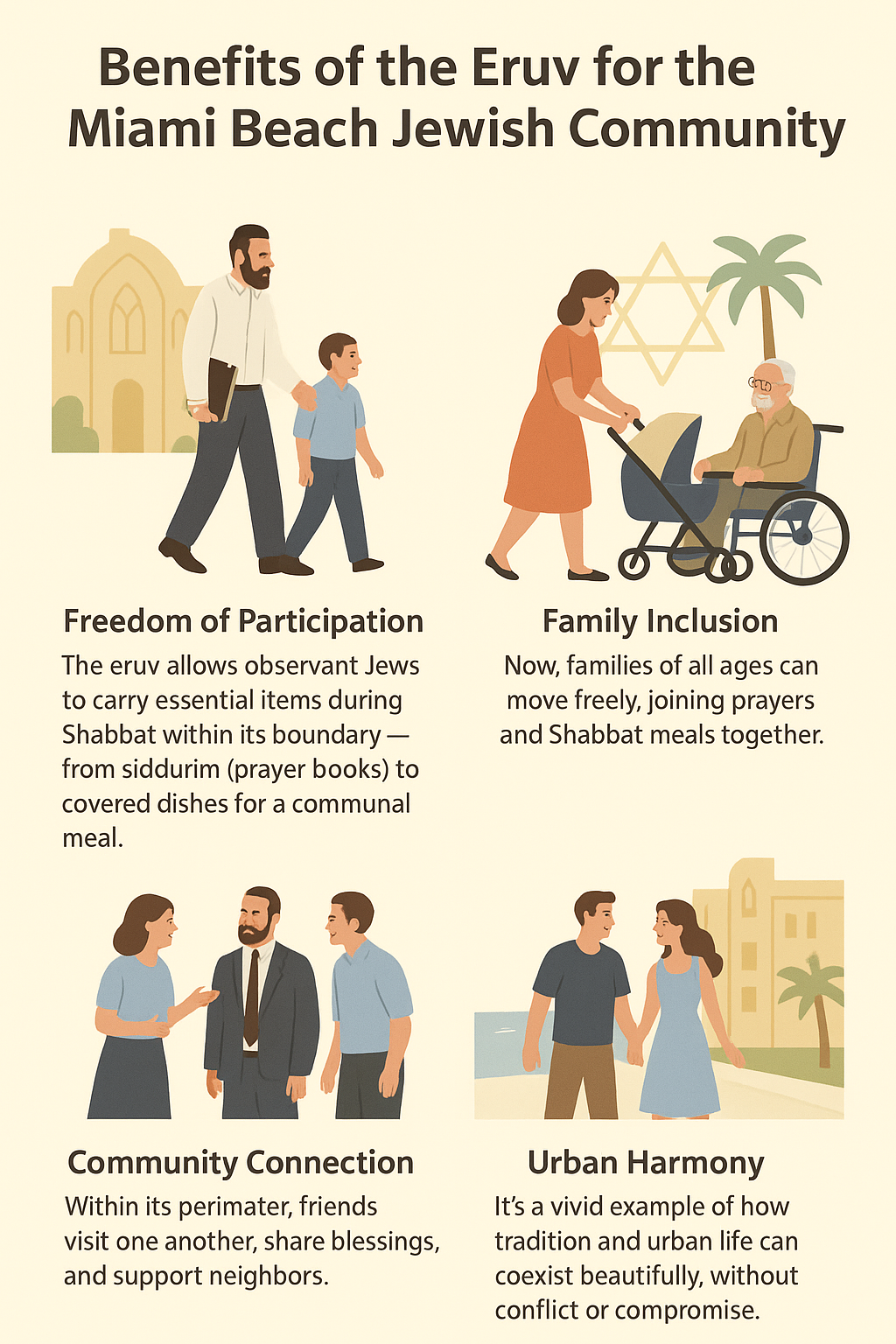
Freedom of Participation
- The eruv allows observant Jews to carry essential items during Shabbat within its boundary — from siddurim (prayer books) to covered dishes for a communal meal. Without it, many would be unable to participate fully in synagogue life or family gatherings. It’s a simple wire, but it bridges faith and freedom in remarkable ways.
Family Inclusion
- Before the establishment of the Miami Beach eruv, parents pushing strollers or individuals using wheelchairs often found it difficult to attend synagogue services. The eruv changed that.
- Now, families of all ages can move freely, joining prayers and Shabbat meals together. This inclusivity has strengthened intergenerational bonds and allowed grandparents, parents, and children to share the Sabbath spirit side by side.
Community Connection
- The eruv doesn’t just create a symbolic wall — it creates a sense of belonging. Within its perimeter, friends visit one another, share blessings, and support neighbors. Whether it’s a Shabbat lunch in South Beach or a stroll in Mid-Beach after synagogue, the eruv reinforces the community’s warmth and unity.
Urban Harmony
- What’s truly inspiring about the Eruv Miami Beach is how seamlessly it integrates into the city’s modern environment. You can walk under palm trees, past Art Deco buildings, and along ocean breezes — all while being inside a centuries-old religious boundary.
- It’s a vivid example of how tradition and urban life can coexist beautifully, without conflict or compromise.
How to Identify the Eruv Boundaries
If you’re visiting or new to the area, it’s helpful to understand where the Miami Beach eruv boundaries lie.
- Look for utility poles connected by nearly invisible wires — these mark the symbolic perimeter.
- Visit the Miami Beach Eruv Official Map for current boundaries and weekly updates.
- Check notice boards at local synagogues or the Miami Beach Jewish Community Center (MBJCC).
- When in doubt, speak to a local rabbi — they’re always happy to guide new visitors or residents.
🔎 Tip: Always confirm the eruv’s weekly status before Shabbat. Wind, rain, or construction can cause a section to break, rendering the eruv temporarily invalid.
Maintenance, Inspection & Community Support

The Eruv of Miami Beach operates through extensive unnoticeable work that most people remain unaware of. The facility perimeter undergoes weekly inspections by trained inspectors and rabbis who search for any gaps or damage during their Thursday and Friday morning inspections. The eruv requires immediate repair whenever a pole becomes dislodged or a wire loses its connection because this work needs to finish before Shabbat starts.
This constant vigilance embodies the community’s dedication and unity.
The synagogue depends on donations and volunteer work for its funding and maintenance because all members actively support the ongoing Jewish community on the island.
💡 How you can help:
Those wishing to contribute can donate or sponsor a weekly inspection via the official Miami Beach Eruv donation page. The continuous flow of donations helps maintain this vital structure which serves as a symbol of religious faith and community bonding and lasting power.
Why the Eruv Matters Beyond Boundaries
The Miami Beach eruv serves as both a religious boundary and a vital connection between people and their faith and their community. The site shows how spiritual practices succeed in a modern resort town that keeps its active character.
For visitors exploring Jewish Miami Beach — from kosher restaurants to historic synagogues — understanding the eruv offers a deeper appreciation of how religion, culture, and community beautifully intertwine here.
Observing Shabbat Within the Eruv – Using the Eruv Properly
For many Jewish residents and visitors, the Eruv Miami Beach is more than a symbolic enclosure — it’s part of daily spiritual life. Still, it must be used with reverence and understanding.
When the eruv is “up” (meaning fully intact and kosher), observant Jews may carry certain items within its boundaries. However, following these guidelines ensures both respect and halachic integrity:
- Carry Only What’s Needed for Shabbat
Items such as siddurim (prayer books), keys, food, or baby essentials are acceptable. Carrying for commercial or recreational purposes isn’t in the spirit of the day. - Stay Within the Boundary
The eruv line creates a defined sacred space. Carrying anything beyond its edge — even by a few feet — violates the rule. Always check the official Miami Beach Eruv map before Shabbat. - Observe Weekly Status Updates
Sometimes weather, wind, or construction can damage part of the structure. When community leaders declare the eruv “down,” carrying becomes prohibited until repairs are complete. - Preserve the Spirit of Rest
Shabbat is about peace, reflection, and renewal. Even when the eruv is active, maintaining that tranquil rhythm honors both the tradition and the city’s serene coastal setting.
These small acts of mindfulness help maintain the eruv’s holiness and communal trust, ensuring it remains a sacred bridge between faith and daily life.
The Broader Community Impact
The Eruv of Miami Beach extends far beyond religious function — it shapes the cultural and social landscape of the city.
The eruv enables families to observe Shabbat without limits which has led to a growing Jewish community throughout the island. The three areas of South Beach and Mid-Beach and North Beach maintain active religious communities through their shared network of kosher eateries and educational institutions.
Its existence has also:
- The community drew Jewish residents who sought to establish a spiritual retirement destination or new start.
- Encouraged Jewish tourism — visitors come to Miami Beach precisely because the eruv supports observant travel.
- The city officials together with community leaders protect the structure through their work to establish better relations between different faiths and cultural groups.
The Miami Beach eruv demonstrates how faith and modern society can exist together in harmony through its unobtrusive boundary that unites religious groups with their urban environment.
Donations & Support – Keeping the Tradition Alive

Maintaining the Miami Beach eruv is a continuous labor of devotion. Inspections occur weekly, often on Thursday mornings, with teams of rabbis and volunteers checking each pole, cable, and connector for integrity. After storms, repair crews move quickly to restore any damage before Shabbat begins.
This ongoing commitment depends on the generosity of donors and synagogue partnerships. Contributions support:
- Weekly inspections and certifications
- Material repairs after hurricanes or coastal weather
- Technical coordination and administrative upkeep
🔗 How to Help:
You can support this essential tradition through the official Miami Beach Eruv Donation Page.
Every donation preserves not only physical maintenance but also a centuries-old practice of unity, peace, and observance that defines Jewish life in Miami Beach.
Visiting Miami Beach as a Jewish Traveler
Exploring Miami Beach through a Jewish lens offers a remarkable balance of spiritual comfort and urban discovery. Within the eruv’s boundary, travelers will find:
- Synagogues: From The Shul of Bal Harbour to Beth Israel Congregation and Temple Menorah, each welcomes visitors for services and Shabbat events.
- Kosher Dining: Along Collins Avenue and 41st Street, kosher restaurants, cafés, and bakeries serve everything from Israeli street food to gourmet cuisine.
- Community Centers: The Miami Beach Jewish Community Center (MBJCC) and nearby Chabad houses host programs, holiday celebrations, and cultural gatherings.
Whether you’re attending Friday night prayers, enjoying kosher dining with ocean views, or walking along the beach in peaceful reflection, the Miami Beach eruv ensures your stay feels both observant and free. It transforms one of Florida’s busiest islands into a haven of faith and belonging.
Conclusion – The Invisible Thread That Connects
Standing beneath Miami’s golden sunset, it’s hard to imagine that a nearly invisible wire — stretched between palm-lined streets and electric poles — holds such profound meaning. Yet for thousands of families, this thread is the lifeline of Shabbat.
The Eruv of Miami Beach unites past and present: ancient Jewish law woven into a vibrant modern city. It allows residents to live fully, celebrate together, and practice faith without barriers.
Supporting the eruv means safeguarding a living symbol — not of restriction, but of connection, compassion, and continuity.
In every quiet walk to synagogue, every shared Shabbat meal, and every child pushed in a stroller under Miami’s warm skies, the eruv whispers its enduring message:
FAQ
The eruv in Miami Beach is a symbolic boundary that allows observant Jews to carry items on Shabbat within its defined area, enabling full participation in community and religious life.
The Miami Beach eruv includes major neighborhoods like South Beach. You can view detailed maps on the official Eruv of Miami Beach website.
Local rabbis, volunteers, and community leaders work together to regularly inspect and repair the eruv to ensure it stays valid and functional.
Yes, the eruv is available to both residents and visitors observing Shabbat. Just be sure to stay within the marked boundaries.
You can support the eruv by donating through the official website or getting involved in community efforts that maintain this important resource.