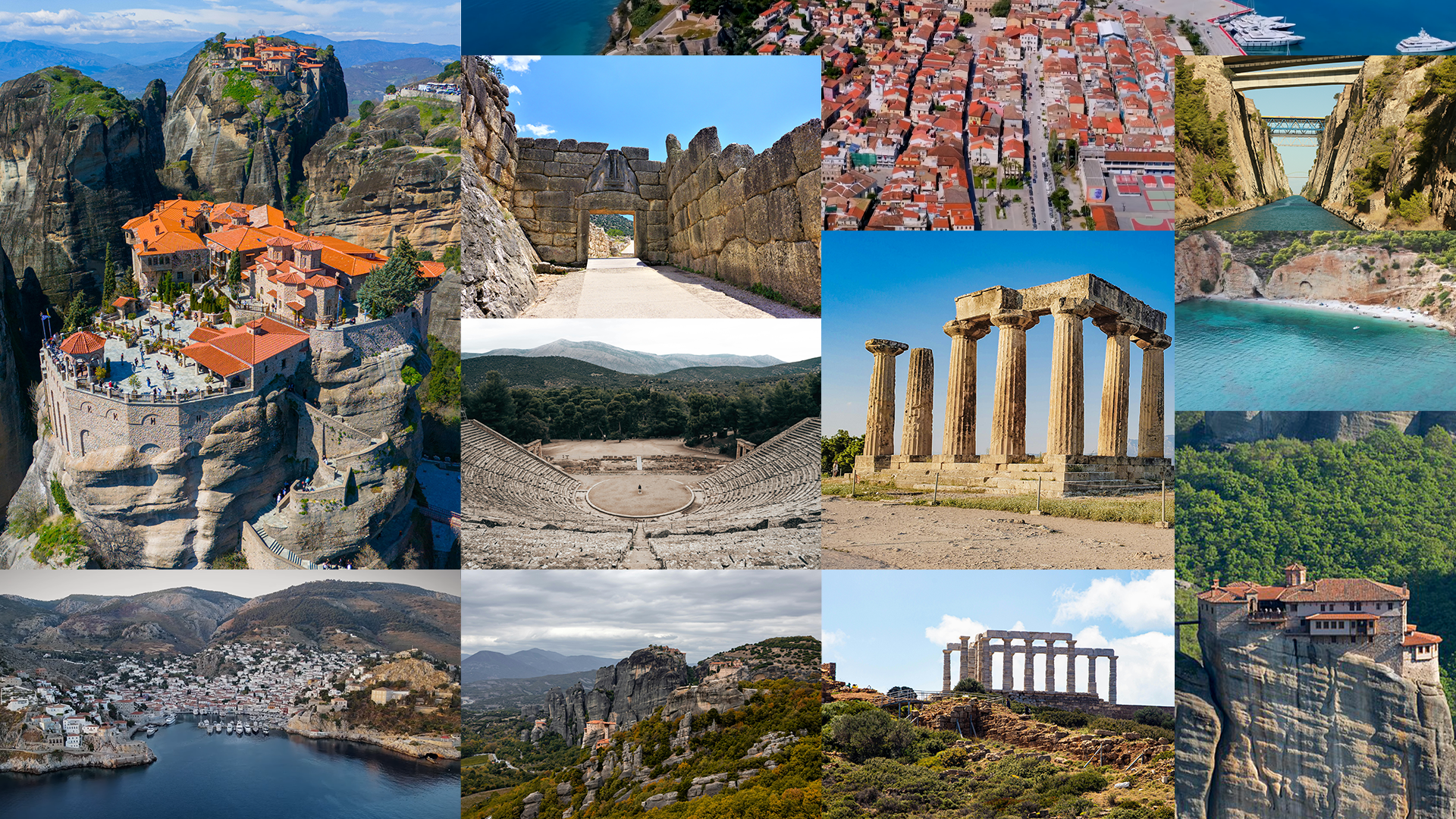
Day trips from Athens Greece completely changed how I saw my vacation last April. You know that feeling when you’re standing at the Acropolis, phone bursting with photos, thinking “alright, what’s next?”
That was exactly me. I’d knocked out the major Athens attractions by day three and started feeling somewhat… restless. My hotel receptionist, Dimitris, spotted me scrolling through Google Maps one morning and grinned. “You need the real Greece,” he said. “Athens is just your starting point.”
He was absolutely right. What began as a standard city break became the kind of adventure I’m still enthusiastically sharing with friends six months later. Here’s the surprising bit—I’m not even a hardcore “travel person.” I typically favour cities over countryside, museums over beaches, coffee shops over outdoor excursions. But something about exploring beyond Athens just felt different.
Within two hours of leaving the city, I found myself at an ancient oracle site where priestesses once channelled divine messages. The next day, I swam off a car-free island where locals still move goods by donkey. By trip’s end, I’d experienced clifftop temples, Byzantine monasteries built on seemingly impossible rock towers, and coastal towns so picturesque they looked unreal.
This guide covers which excursions from Athens actually deserve your limited holiday time, honest costs for real budgets, and practical information other travel blogs consistently skip.
Table of Contents
Why Athens Makes the Perfect Base for Exploring Greece
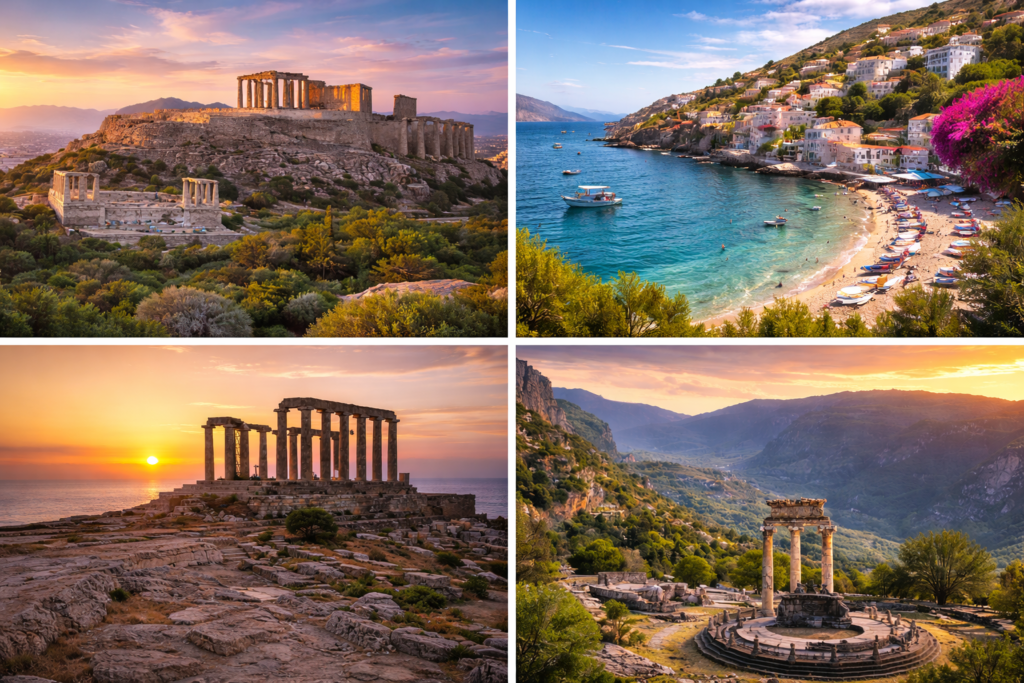
Look, I understand. When dreaming about Greece, you’re probably not imagining a bustling capital city. You’re picturing whitewashed villages on cliff edges, right?
But here’s what completely shifted my perspective: Athens isn’t just another city to tick off. It’s your strategic headquarters for accessing Greece’s best without the constant packing nightmare.
The Geographic Sweet Spot
Athens sits perfectly positioned at the center of everything worthwhile. Saronic Gulf islands start just 40 minutes away by ferry. Ancient Peloponnese sites are one to two hours south. Mountain sanctuaries lie two to three hours north. You can literally enjoy breakfast watching sunrise over the Acropolis, spend your day exploring completely different landscapes, and return for dinner at that taverna you loved.
I stayed in one Athens apartment for eight nights and visited eight completely different places. No repacking. No hotel checkouts. Just easy day trips from Athens feeling like traveling through entirely different countries.
Transport That Actually Works
The Greek KTEL bus network connects Athens to virtually everywhere. Buses are modern, air-conditioned, and significantly cheaper than car rentals. Most tickets cost €7-20 each way. The Piraeus Port Authority handles multiple islands with hourly summer departures.
Your Budget Will Thank You
Staying in Athens saves serious money. Athens apartments cost €60-90/night versus Santorini’s €180-300/night. That €100+ nightly savings funds actual experiences—organized tours, ferries, nice dinners, and archaeological site entries.
Ancient Archaeological Sites Worth Your Time
Greece has more ancient ruins than you can possibly visit in one trip. The question isn’t “are there ancient sites near Athens?” but rather “which ancient sites are worth the travel time?”
I’m going to be straight with you: not every archaeological site deserves a full day. Some are incredible, perspective-shifting experiences. Others are “cool, we saw some old rocks” situations. Let me break down the truly special ones for day trips from Athens.
Delphi: The Oracle Site That Lives Up to the Hype
- Distance: 180 km northwest of Athens (2.5 hours drive)
- Why go: UNESCO World Heritage site, dramatic mountain setting, actual chills from the history
- Time needed: 5-6 hours including travel
- Location: Delphi 330 54, Greece
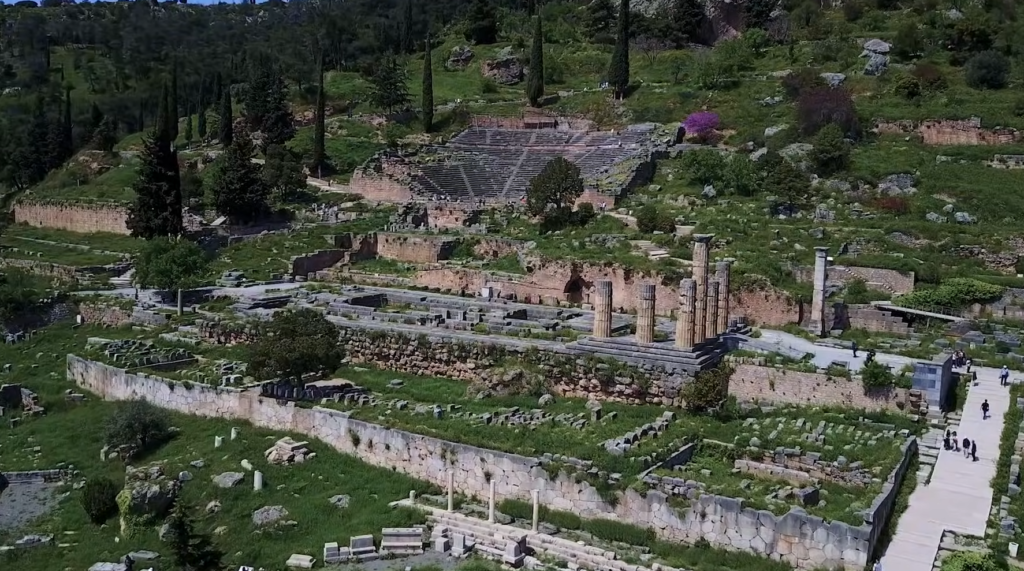
I put off visiting Delphi for my first two Greece trips because “ancient ruins all look the same, right?” Wrong. So incredibly wrong.
Delphi hits different. Maybe it’s the location—perched on Mount Parnassus with views over olive-covered valleys that stretch to the Gulf of Corinth. Maybe it’s knowing this was literally the center of the ancient world, where kings and generals came seeking prophecy before major decisions. Also Maybe it’s that the archaeological site genuinely takes your breath away.
The ancient Greeks believed Zeus released two eagles from opposite ends of the world, and they met here at Delphi, marking Earth’s center. The Oracle of Delphi—a priestess who entered trance states to channel Apollo’s messages—influenced basically every major event in Greek history for over a thousand years.
Walking up the Sacred Way toward the Temple of Apollo, you pass treasuries built by different city-states showing off their wealth. The theater seats 5,000 and still has perfect acoustics. The stadium at the top hosted Pythian Games, the ancient world’s second-most important athletic competition after the Olympics.
What makes it special:
- The Delphi Archaeological Museum houses mind-blowing artifacts including the Bronze Charioteer
- The Tholos at Athena Pronaia sanctuary (those three columns you’ve seen in every Greece photo collection)
- Mountain air that somehow smells different than anywhere else
- The actual ancient spring where priestesses purified themselves
Getting there for day trips from Athens:
- KTEL bus from Athens Terminal B: €16.60 one way, 3 hours with stops
- Organized tours: €50-70 including transport and guide
- Self-drive: Most scenic but Athens traffic is intense
Money-saving trick: The €12 site entrance includes the museum. Go early (8am opening) or late afternoon (after 3pm) when tour groups thin out. Midday summer heat makes the uphill walk brutal anyway.
My mistake so you don’t repeat it: I didn’t bring enough water. The site has limited shade and one overpriced café. Pack 2 liters per person minimum, plus snacks. Also, wear proper shoes—those marble paths get slippery.
The village of Delphi itself is small but pleasant. Stop for lunch at one of the tavernas with valley views. The local wine comes from vineyards literally visible from your table.
Mycenae & Epidaurus: Bronze Age Power & Perfect Acoustics
- Distance: 120 km southwest (1.5-2 hours)
- Why go: Walk through Agamemnon’s legendary kingdom, experience ancient theater acoustics
- Time needed: Full day (usually combined trip)
- Location: Mykines 212 00, Greece
These two sites pair together brilliantly, and most organized tours hit both in one day. That’s smart planning because they’re only 30 minutes apart and tell complementary stories.
Mycenae: Where Legends Became History
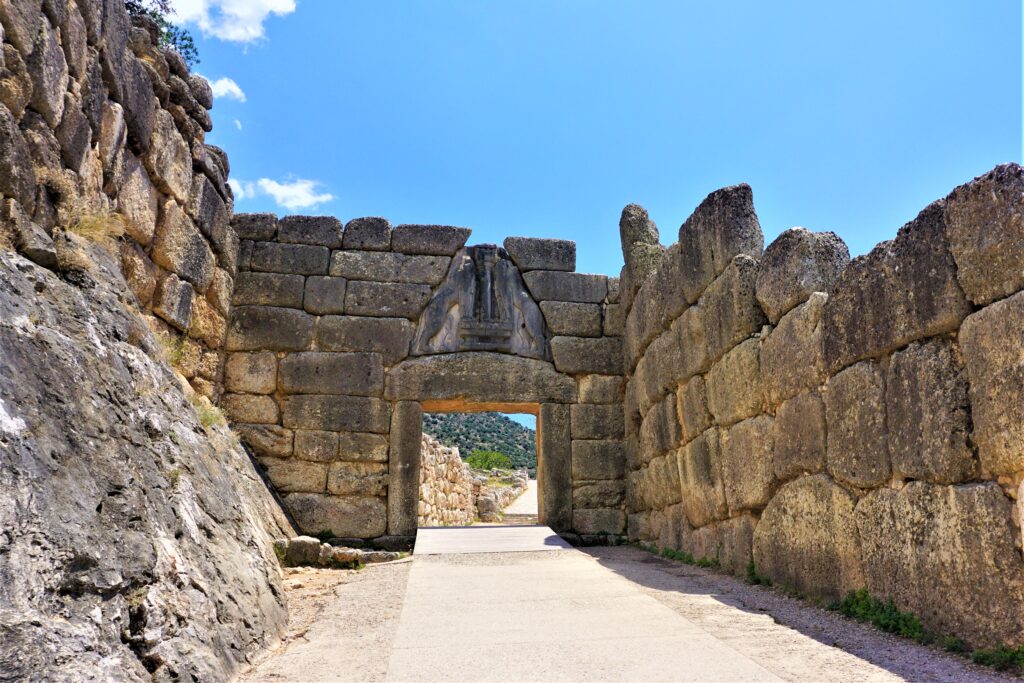
Heinrich Schliemann showed up here in the 1870s with Homer’s Iliad in hand, determined to prove Troy and Mycenae were real, not mythological. He was right. The massive citadel he uncovered proved this was the center of Bronze Age civilization (1600-1100 BC).
Walking through the Lion Gate—those two lions carved above the entrance in 1250 BC—gives you chills. These stones were old when the Parthenon was built. The cyclopean walls use boulders so massive that later Greeks thought only Cyclops giants could have moved them.
Inside the citadel, you’ll find:
- Royal palace foundations with still-visible megaron (throne room)
- Grave circles where Schliemann found gold death masks
- Secret underground cistern that held water during sieges
- Treasury of Atreus—a beehive tomb outside the main site
The archaeological museum on-site displays finds including weapons, gold jewelry, and pottery that proved Mycenaean civilization was real, powerful, and sophisticated.
Epidaurus: Acoustic Magic That Seems Impossible
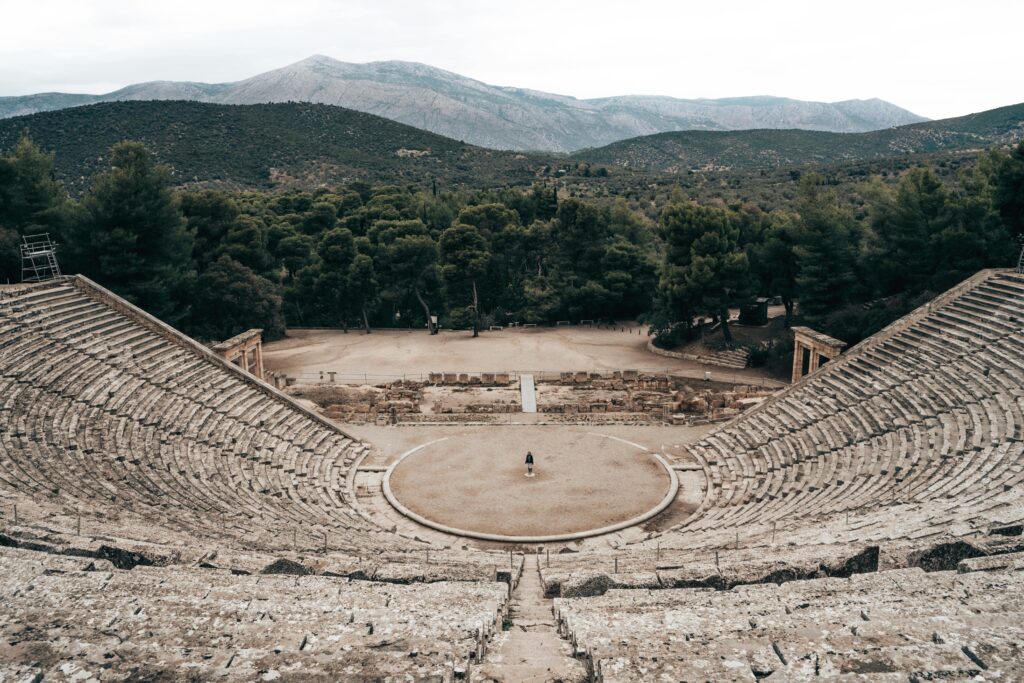
Thirty minutes south sits the Sanctuary of Asclepius at Epidaurus, ancient Greece’s most important healing center. People came from across the Mediterranean seeking cures, combining medicine with religious rituals.
But everyone comes for one thing: the theater.
This 4th-century BC theater seats 14,000 people across 55 rows. The acoustics are so perfect that a match struck in the orchestra circle can be heard clearly in the top row 60 meters away. Engineers still don’t fully understand how they achieved this without modern technology.
Every tour guide does the demonstration. Someone stands center stage, whispers, maybe drops coins on the stone. Then they have people sit in the highest seats and repeat it. It works. Every single time. Your brain knows it shouldn’t work, but your ears prove it does.
Summer bonus: From June through August, the Athens & Epidaurus Festival stages ancient Greek plays here. Watching Euripides performed in the actual theater it was written for, under stars, with 14,000 other people… that’s bucket-list material.
Practical details for this day trip from Athens:
- Combined site entry: €12 Mycenae + €12 Epidaurus
- Organized tours: €90-140 (often includes Nafplio stop)
- KTEL buses: Possible but requires changes, tours are easier
- Best months: April-May and September-October for comfortable temperatures
Pro insight: Most tours rush Mycenae to get to Epidaurus. If you’re driving yourself, do Epidaurus first thing in the morning when it’s empty, then Mycenae second. The citadel actually looks more dramatic in afternoon light anyway.
Ancient Corinth & The Engineering Marvel Canal
- Distance: 80 km west (1 hour drive)
- Why go: Quick half-day trip, impressive canal, historically important city
- Time needed: 3-4 hours total
- Location: Argous 105, Archea Korinthos 200 07, Greece
Ancient Corinth was filthy rich. Like, absurdly wealthy. The city sat at the crossroads of east-west Mediterranean trade, controlling the narrow isthmus connecting central Greece to the Peloponnese. Every merchant paid fees to transport goods across. Cha-ching.
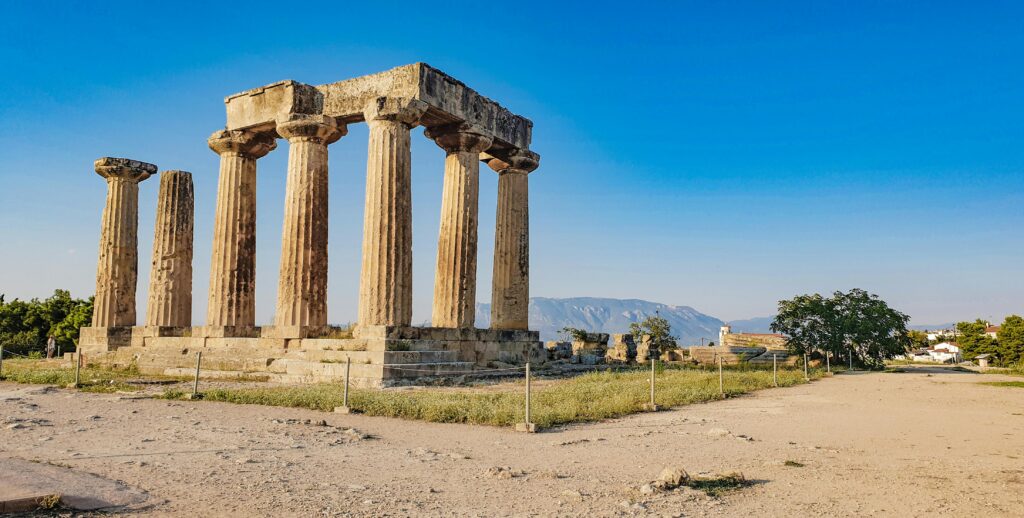
The site today centers around the Temple of Apollo, with seven original columns still standing from 550 BC. That’s old even by Greek standards. The ancient marketplace (agora) sprawls below, with foundation walls showing dozens of shops, fountains, and public buildings.
Biblical history note: St. Paul spent 18 months preaching in Corinth around 50-51 AD. The archaeological remains include the Bema (judgment seat) where Paul was tried by the Roman proconsul.
But let’s be honest—most people come for the Corinth Canal.
The Corinth Canal: When Humans Said “Watch This”
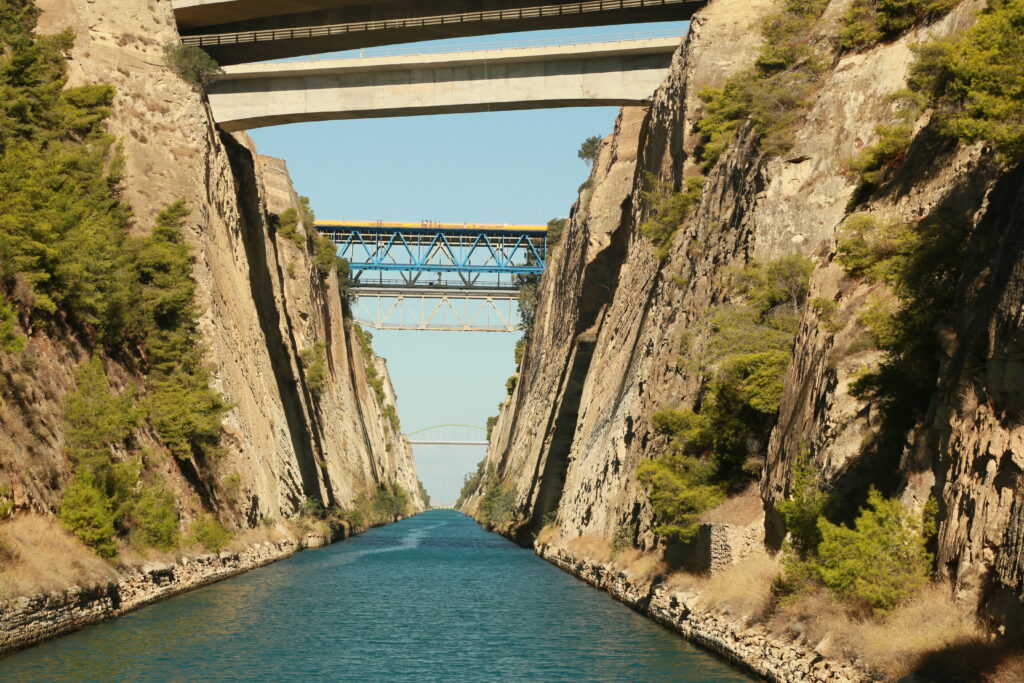
Picture a knife cutting through a birthday cake, except the cake is solid rock and the knife took 11 years. The Corinth Canal, completed in 1893, slices 6.4 kilometers through the narrowest part of the isthmus. It’s only 25 meters wide, with sheer rock walls rising 90 meters on both sides.
Stand on the bridge and look down. Your stomach does that little flip thing. The water looks impossibly far below. Occasionally a ship squeezes through—barely fitting with just meters of clearance on each side.
Thrill-seeker bonus: Zulu Bungy operates bungee jumping from the bridge. I watched people do it. I did not do it myself. Also I have limits.
Getting here from Athens:
- KTEL buses: Every 30-45 minutes (€7 one way)
- Canal viewing: Free from bridge
- Ancient Corinth site: €8 entrance
- Perfect for: Morning trip, back to Athens by lunch
Combine it wisely: The ancient site alone isn’t worth the trip for most people. But combined with the canal, Acrocorinth fortress (dramatic views), and maybe continuing to Nafplio, it makes a solid day.
Cape Sounion: The Sunset That Broke Instagram
- Distance: 70 km southeast (1-1.5 hours via coastal road)
- Why go: Most photographed sunset spot in Greece, clifftop temple, dramatic coastline
- Time needed: 3-4 hours (time your visit for sunset)
- Location: Lavreotiki 195 00, Greece
Okay, let’s address this upfront: Cape Sounion is touristy. Like, really touristy. Buses, crowds, selfie sticks everywhere. But you know what? It totally deserves the hype.
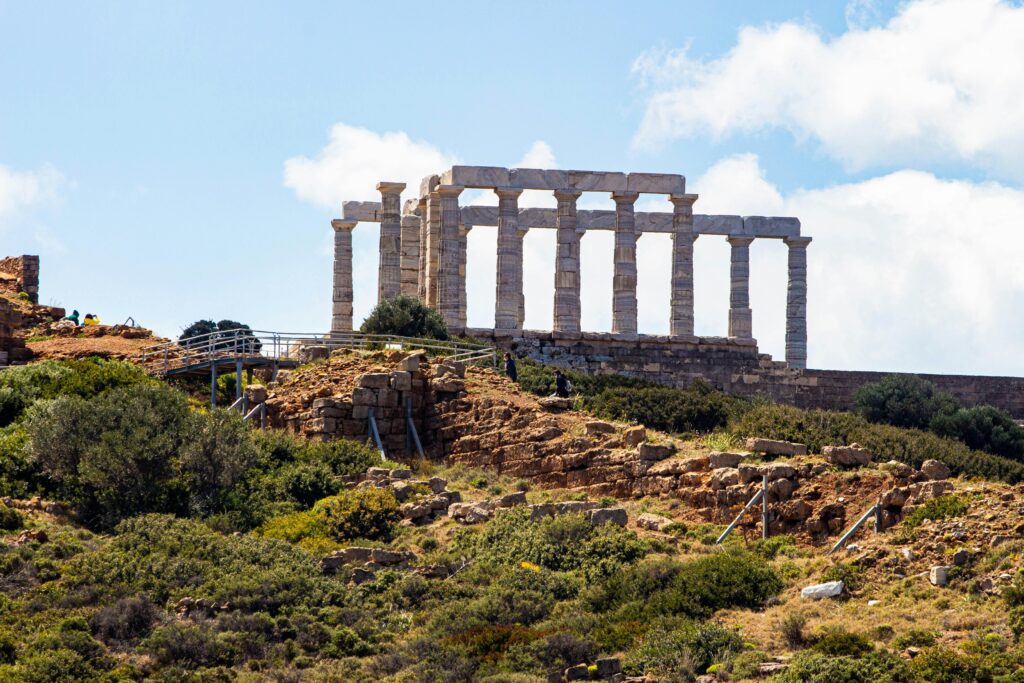
The Temple of Poseidon sits on a cliff 60 meters above the Aegean Sea, built in 444 BC from local marble. Ancient sailors would round this cape and make offerings to Poseidon, god of the sea, praying for safe passage home.
Fifteen of the original 34 columns still stand. As sunset approaches, the white marble transforms—first honey-gold, then deep orange, then glowing pink. The sea turns from blue to purple to black. On clear evenings, you’ll see islands scattered across the horizon: Kea, Kythnos, sometimes even Serifos.
Lord Byron carved his name on one of the columns in 1810. Don’t do this. Seriously. It’s illegal, culturally disrespectful, and also he’s Lord Byron and you’re not. But I get why he felt compelled—there’s something about this place that makes you want to mark the moment permanently.
Why sunset is non-negotiable:
- The temple literally glows in golden hour light
- Temperature drops from sweltering to pleasant
- Fewer crowds than midday (though still crowded)
- You understand why ancient Greeks built temples to gods here
Planning your trip to Cape Sounion:
- Site entrance: €10 (April-October), €5 (November-March)
- Arrive: 1 hour before sunset
- KTEL bus from Viktoria Square: €7.20, takes 2 hours with stops
- Organized sunset tours: €40-55 with transport
- Self-drive: Coastal route via Vouliagmeni is stunning
Critical warning: The last bus back to Athens leaves shortly after sunset. Miss it and you’re stuck. Double-check the schedule or book a tour. Taxis from Cape Sounion back to Athens run €80-100.
The better way to do it: Rent a car or scooter. Drive down the coastal road (the Athens Riviera route) stopping at beaches along the way. Vouliagmeni, Varkiza, Lagonissi all have great swimming. Arrive at Sounion by 6pm, watch sunset, then drive back stopping in Vouliagmeni for dinner by the water.
I’ve done Cape Sounion four times now—twice by bus (stressful timing), once on a tour (crowded bus, rushed), once by rental car (perfect). The car wins.
Greek Islands You Can Actually Visit as Day Trips from Athens
Here’s where Athens shows its true value. The Saronic Gulf islands give you authentic Greek island experiences without flights, without expensive island hotels, and without wasting half your vacation in transit.
These aren’t the famous Instagram islands. You won’t find Santorini’s blue domes or Mykonos’s party beaches. What you will find: genuine island culture, clearer water, fewer crowds, and prices that don’t require a second mortgage.
Aegina: Your First Taste of Island Life
- Ferry time: 40 minutes (Flying Dolphin) to 1 hour 20 minutes (regular ferry)
- Why go: Closest island, family-friendly, pistachios, ancient temple
- Cost: €8.50-14.50 one way
Aegina introduces you to Greek islands gently. It’s busy (Athenians flock here on weekends) but not overwhelming. Developed enough for convenience, authentic enough to feel real.
The moment you step off the ferry at Aegina Town harbor, vendors will ambush you with pistachio samples. Aegina pistachios are legitimately the best in Greece—smaller, greener, more flavorful than anywhere else. They’re protected designation of origin certified, meaning real Aegina pistachios only come from here.

Buy the fresh-roasted ones from harbor vendors (€10-15 for a good-sized bag). Skip the packaged tourist shop versions. I’ve hauled home 3 kilos worth of Aegina pistachios across my various trips. Zero regrets.
What to actually do on Aegina:
The Temple of Aphaia sits on a pine-covered hillside offering incredible island views. Built around 500 BC, it’s one of Greece’s best-preserved ancient temples. Here’s a cool fact: it forms a perfect equilateral triangle with the Parthenon and Temple of Poseidon at Sounion. Ancient Greeks were into sacred geometry apparently.
Beach options:
- Agia Marina: Most developed, sandy, family-friendly, gets crowded
- Souvala: Quieter north coast, pebble beaches, more local feel
- Marathon Beach: East coast, good swimming, tavernas nearby
Hidden gem: Paleochora is an abandoned medieval town inland with 38 Byzantine churches scattered across hillsides. Most tourists skip it entirely. Takes about an hour to explore, offers silence and mountain views.
Getting around:
- Rent bikes: €10/day (island is mostly flat)
- Rent scooters: €25-30/day
- Local buses: €2-3, connect main villages
- Taxis: Available but pricy for full-day hire
Food situation: Harbor tavernas serve fresh seafood but tourists pay tourist prices. Walk inland three blocks and find family-run spots where locals eat. The grilled octopus everywhere on Aegina is exceptional—they know how to do it.
Practical planning:
- Ferry schedules: Multiple companies, hourly departures
- Temple entrance: €6
- Best for: Families, first-time island visitors
- Avoid: Summer weekends if you hate crowds
My honest take: Aegina isn’t dramatic or foreign. It’s pleasant, accessible, and easy. Perfect if you’ve never done a Greek island before and want to test the waters (literally).
Hydra: Where Cars Don’t Exist and Time Moves Slower
- Ferry time: 2 hours (regular ferry) or 1.5 hours (Flying Cat)
- Why go: Unique car-free environment, artists’ colony, timeless atmosphere
- Cost: €28-55 one way depending on ferry type
Step off the boat in Hydra and the first thing you notice is what’s missing: engine noise. No cars. No motorcycles. Also No trucks. Transportation is by donkey, water taxi, or walking. That’s it.
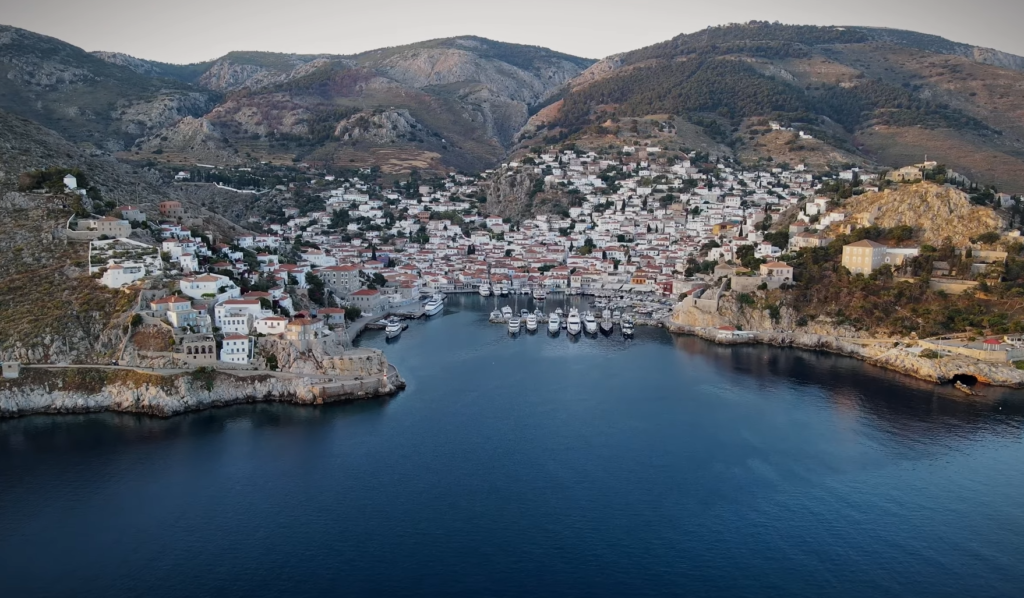
The island banned motor vehicles decades ago and never looked back. It’s one of the few places left where you can actually hear the sea.
Stone mansions cascade up steep hillsides from the harbor in shades of cream and white with red-tile roofs. Narrow cobblestone paths wind upward, too steep and narrow for anything except foot traffic. Cats own the place—they’re everywhere, sunbathing on steps, hunting in alleyways, accepting tourist pets graciously.
Why Hydra attracts artists:
Leonard Cohen lived here in the 1960s. His house (now private) sits above the main harbor. The quality of light, the slow pace, the isolation—artists have been drawn here for 60+ years. You’ll find more galleries per capita than almost anywhere in Greece.
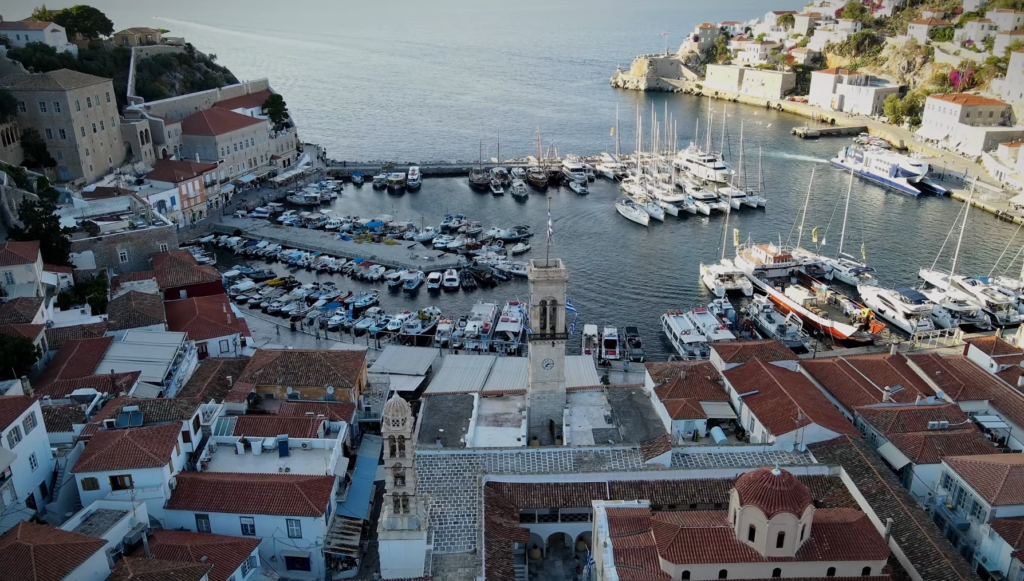
The island forces you to slow down. You literally can’t rush—those cobblestone paths won’t let you. It’s meditative whether you want it to be or not.
What to do:
- Swim at Vlychos Beach (20-minute coastal walk)
- Hike to Profitis Ilias Monastery (1.5 hours up, incredible views)
- Gallery hop around the harbor
- Take water taxi to remote swimming coves (€10-15)
- Watch donkeys carry supplies up the hills
Where to eat:
- Sunset Restaurant: Upscale, water views, €30-40 per person
- Xeri Elia Taverna: Traditional, family recipes, climb to find it
- Pirofani: Fresh fish, harbor location, mid-range prices
Reality check: Hydra gets absolutely slammed when cruise ships dock. Suddenly 3,000 people flood a small island built for maybe 500 tourists. The magic evaporates completely.
How to handle this: Check cruise schedules before booking your ferry. CruiseMapper shows cruise arrivals. Visit midweek if possible. Better yet, stay overnight—Hydra transforms after day-trippers leave. The harbor at night, lit by taverna lights reflecting on still water, is pure magic.
Costs for day trips from Athens to Hydra:
- Ferry: €28-55 depending on speed
- Food: €20-35 per person (pricier than mainland)
- Water taxis: €10-20 to beaches
- Accommodations if staying over: €80-150/night
Three-island cruise option: Many tour companies offer Hydra + Poros + Aegina day cruises (€80-110 including lunch, transport, and brief time on each island). These work okay if you’re time-crunched but you only get 1-2 hours per island. I prefer dedicating full days to fewer places.
Poros: The Island That Flies Under the Radar
- Ferry time: 1 hour (Flying Dolphin) to 2.5 hours (regular ferry)
- Why go: Authentic, affordable, beautiful, and tourists haven’t ruined it yet
- Cost: €8.50-26 one way
Poros gets unfairly overlooked between famous Hydra and popular Aegina. Which makes it perfect for travelers who want authentic Greek island vibes without performing for Instagram.
The island (technically two islands connected by a narrow bridge) sits so close to the Peloponnese mainland that the channel between them measures just 200 meters across. You can wave to people on the opposite shore. Water taxis shuttle between Poros Town and mainland Galatas every few minutes for €1.
Pine forests blanket much of the island, giving the air that fresh, resinous scent. The main town tumbles down hillsides to the waterfront in a jumble of white and pastel houses. It’s less polished than Hydra, less touristy than Aegina, and that’s exactly its charm.
What to explore:
- Clock tower area: Best panoramic views, bring your camera
- Sanctuary of Poseidon: Ancient temple ruins, peaceful walk
- Russian Bay: Crystal clear swimming, pine trees to the water’s edge
- Love Bay: Quieter beach, locals’ favorite
- Monastery of Zoodochos Pigi: Beautiful 18th-century monastery
Bike the island: The main road circles Poros in about 12 kilometers. Rent a bicycle (€10-12/day) or scooter (€20-25/day) and spend the afternoon exploring. The route passes beaches, forest paths, and small villages.
Cross to Galatas: The mainland town opposite Poros offers a different vibe and excellent lemon forest just outside town. The water taxi costs €1 and takes 3 minutes.
Where to eat well:
- Taverna Oasis: Family-run, traditional cooking, great prices
- Poseidon Restaurant: Harbor location, fresh fish, generous portions
- Aspros Gatos: Coffee and pastries, local hangout
Budget-friendly reality: Poros costs noticeably less than Hydra for everything—food, drinks, water taxis. A full meal at a good taverna runs €12-18 per person versus €25-35 on Hydra.
Best for: Solo travelers, couples, anyone exhausted by Instagram culture. If you want to just exist on a Greek island without performance, Poros delivers.
Agistri: The Secret Greek Island Nobody Talks About
- Ferry time: 55 minutes to 1 hour 10 minutes
- Why go: Incredible beaches, zero crowds, authentic village life
- Cost: €8-12 one way
Most Athens travel guides barely mention Agistri. Which is precisely why it made my list.
This tiny island (only 13 square kilometers) sits just beyond Aegina in the Saronic Gulf and remains wonderfully under-the-radar. No cruise ships. No sprawling resorts. Just pine forests growing down to crystal-clear beaches and a few small villages.
International tourists haven’t discovered it yet. Athenians know about it—they escape here on summer weekends—but the word hasn’t spread to tour groups. Visit midweek and beaches are nearly empty.
The beaches that make it worthwhile:
- Aponisos Beach: Sandy, organized (umbrellas available), family-friendly, bar service. This is “busy” Agistri, meaning maybe 40 people on a summer afternoon.
- Dragonera Beach: Pebbles, crystal-clear water, incredible snorkeling around rocks. Bring water shoes. Nearly empty except August weekends.
Chalikiada Beach: Pine trees meet turquoise water, small pebbles, perfect for swimming. My personal favorite.
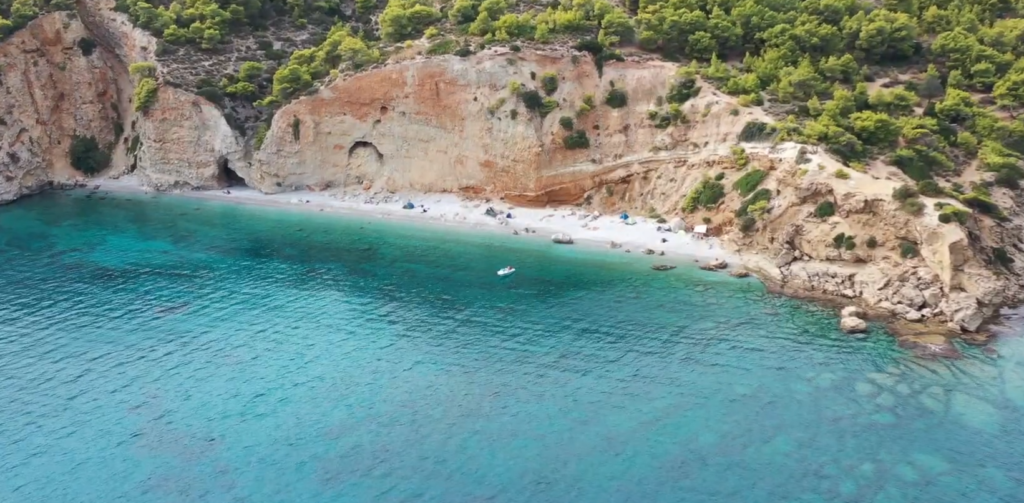
- Mariza Beach: Southeast coast, requires effort to reach (scooter or hike), rewards you with isolation and pristine water.
Getting around Agistri:
The island is tiny but roads are hilly. Walking between beaches takes time and effort in summer heat. Solutions:
- Rent quad bikes: €30-35/day (most popular option)
- Rent bicycles: €12-15/day (requires fitness for hills)
- Local bus: Limited schedule, connects Skala and Megalochori
- Hitchhike: Locals are friendly, island is safe
Two villages:
- Skala: Port town, most accommodations, restaurants, beach access. Where ferries arrive.
- Megalochori: Inland village, traditional architecture, quieter atmosphere, locals’ favorite tavernas.
Planning tips:
- Direct ferries from Piraeus or via Aegina
- Many tours combine Agistri with Aegina day trips
- Bring cash (limited ATMs)
- Book taverna dinner ahead in summer (limited restaurants)
- Stay overnight if possible (day trip feels rushed)
Who it’s perfect for: Couples seeking peace. Solo travelers who brought a good book. Families with kids who just want to swim without crowds. Anyone exhausted by overtourism.
Who should skip it: Party people. Instagram influencers. Anyone who needs constant activity options. Luxury travelers (accommodations are basic).
I spent a day here after Aegina, fully expecting to be underwhelmed. Instead, I nearly changed my flight to stay longer. That’s the danger of Agistri—it sneaks up on you.
Coastal Towns That Deserve Your Time
Greece does coastal towns differently. These aren’t resort towns built for tourism. They’re real places with actual history, where locals live and work, that just happen to be absurdly beautiful.
Nafplio: The Most Romantic Town in Greece
- Distance: 140 km southwest (2 hours drive)
- Why go: Venetian architecture, seaside fortresses, best Greek town atmosphere
- Time needed: Full day minimum (overnight better)
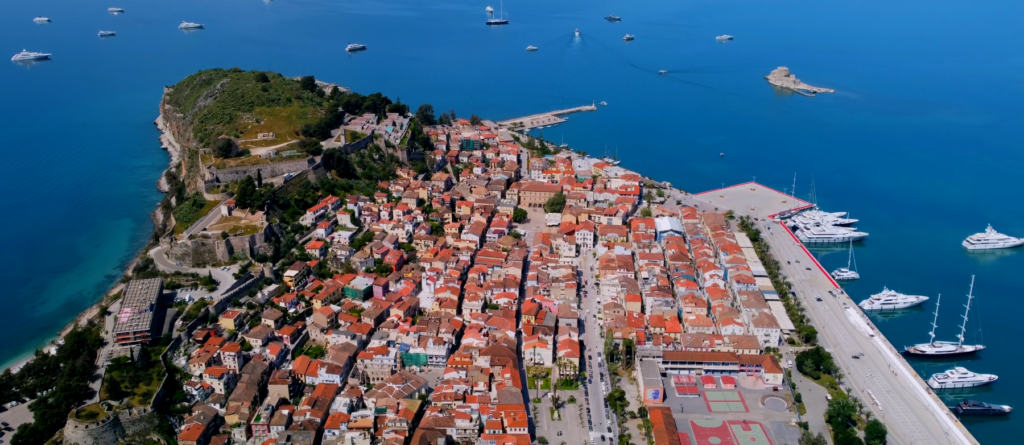
If I could convince you to do just one day trip from Athens Greece beyond the islands, Nafplio would be it. This gorgeous seaside town served as Greece’s first capital after independence (1829-1834), and it wears that heritage beautifully.
Picture narrow marble-paved streets lined with neoclassical mansions in pastel colors. Bougainvillea spilling over wrought-iron balconies in explosions of pink and purple. Venetian fortresses looming over terra-cotta rooftops. Harbor cafés where old men play backgammon for hours. That’s Nafplio.
The old town is made for wandering aimlessly. No map needed. Just walk. Every corner reveals something Instagram-worthy—a hidden courtyard, a 19th-century fountain, a tiny church wedged between buildings.
Three fortresses tell the story:
Palamidi Fortress: The intimidating one. Built by Venetians in 1711-1714, sitting 216 meters above sea level. To reach it, you climb 999 steps (or drive up the back road like smart people). The views reward every single step—Nafplio spreads below, the Argolic Gulf sparkles beyond, mountains frame everything.
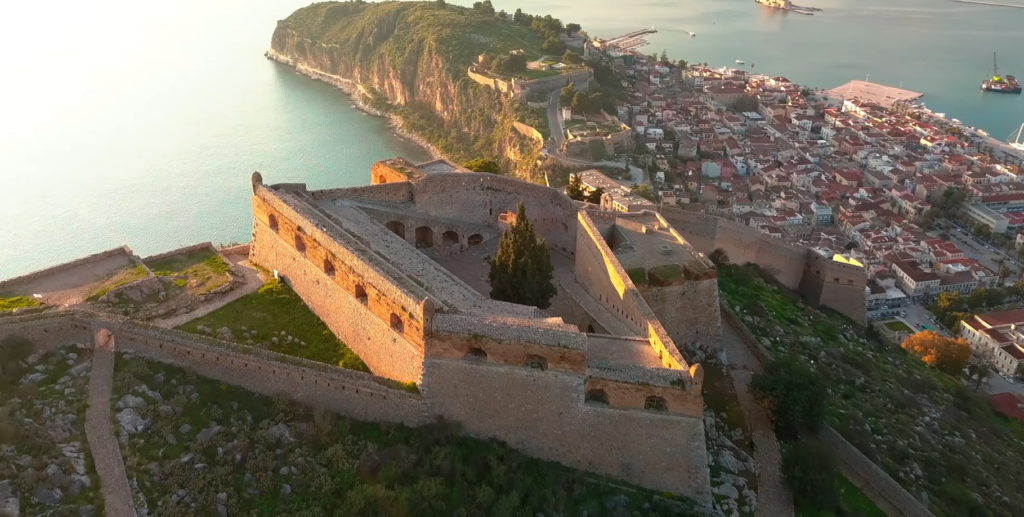
- Bourtzi Castle: The picturesque one. This small fortress sits on a tiny island in the harbor, connected by boat trips (€5 round trip). Built in 1473, it’s protected Nafplio’s harbor for 550 years. Now it hosts concerts and exhibitions in summer.
- Akronafplia: The ancient one. This citadel’s foundations date to Bronze Age (before 1200 BC). Sections were added by Greeks, Romans, Byzantines, Venetians, and Ottomans. It’s basically a timeline of Mediterranean history in fortress form.
What to actually do:
- Morning: Start at Syntagma Square with Greek coffee. Explore the old town’s marble streets—get lost deliberately. Visit the Archaeological Museum (€6, excellent Mycenaean collection).
- Midday: Lunch at the harbor watching fishing boats. Every taverna serves fresh seafood caught that morning. Go where you see locals, not where menus have photos.
- Afternoon: Either hike Palamidi (early afternoon, before it gets too hot) or relax at Arvanitia Beach, a 5-minute walk from town center. The beach is small, pebbly, and perfect for swimming with fortress views above.
- Evening: Stroll the Bouboulina waterfront promenade at sunset. Dinner in the old town’s atmospheric alleys. Watch street musicians in Syntagma Square.
Where to eat well:
- Alaloum: Traditional Greek, amazing lamb dishes, reservations essential
- Pidalio Mezedopoleio: Seafood meze, harbor views, mid-range prices
- 3Sixty: Rooftop restaurant, modern Greek cuisine, splurge option
- Souvlaki Grill: Best cheap eat, authentic, locals line up
Getting to Nafplio from Athens:
- KTEL bus: €14 one way, 2.5 hours, comfortable
- Organized tours: €90-140 (usually combined with Epidaurus/Mycenae)
- Rental car: Best option for flexibility
Why overnight is worth it:
Nafplio transforms after the day-trippers and tour buses leave. The old town gets quieter. Locals reclaim the harbor cafés. You can have morning coffee watching fishing boats unload their catch. Evening walks along the waterfront without crowds. Sunrise from Palamidi fortress with zero tourists.
I’ve done Nafplio both as a day trip and overnight. Overnight wins easily. Book one of the restored mansions turned boutique hotels (€70-120/night)—they’re stunning and priced fairly.
Combine it smartly: Nafplio pairs perfectly with Mycenae and Epidaurus. Many tours hit all three in one long day (10-12 hours total). Or do what I prefer: drive to Mycenae first thing morning (before heat and crowds), Epidaurus late morning, arrive Nafplio by 2pm, stay overnight, return to Athens next afternoon.
Athens Riviera: Beach Clubs and Coastal Escapes
- Distance: 15-30 km southeast (30-60 minutes)
- Why go: Beach day without leaving greater Athens, luxury options, thermal spa
- Time needed: Half day to full day
Sometimes you just need a beach day without traveling far. The Athens Riviera delivers exactly that—a stunning stretch of coastline from Piraeus to Cape Sounion with organized beaches, beach clubs, and the famous Vouliagmeni thermal lake.
This is where wealthy Athenians spend their summers. You’ll see more Porsches and yachts than anywhere else in Greece. But you don’t need to be rich to enjoy it—there are options for every budget.
Vouliagmeni: The Crown Jewel
Vouliagmeni Lake is something special. This natural thermal spa sits in a rocky cove, fed by underground hot springs that keep the water between 22-29°C year-round. The mineral-rich water supposedly has therapeutic properties for skin conditions and rheumatism.
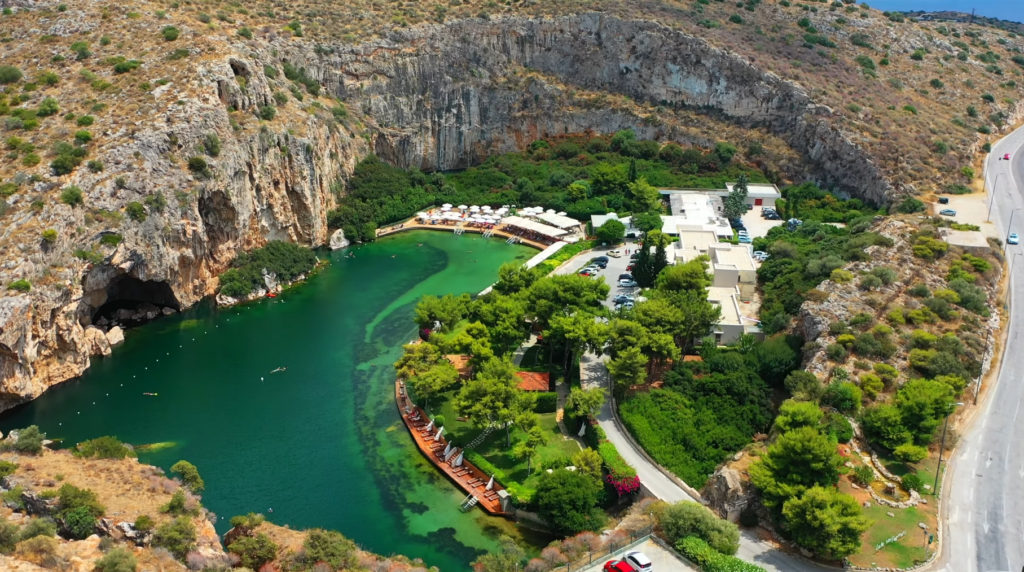
Swimming here feels like discovering a secret paradise. Steep cliffs surround the lake. Warm water supports you effortlessly (high mineral content). Small fish nibble your feet (free fish spa therapy—weird but pleasant). On winter days when the Aegean is too cold for swimming, Vouliagmeni stays comfortably warm.
Entrance: €14 (weekdays), €16 (weekends). Worth every cent. Open until late evening. Bring water shoes—the bottom can be rocky in places.
Beach clubs and organized beaches:
- Astir Beach: The luxury option. Part of Four Seasons Astir Palace hotel but open to public. White umbrellas, manicured sand, beach service, seaside restaurant. Entry €25-40 depending on season and where you sit.
- Varkiza Beach: Large organized beach with reasonable prices. Umbrellas €12-15 for the day. Good swimming, family-friendly, water sports available. Busy on weekends but spacious enough to not feel crowded.
- Lagonissi: Further south, quieter, more local crowd. Mix of free beach areas and organized sections. Crystal-clear water, less developed than Vouliagmeni/Varkiza.
Free alternatives:
Not every beach charges entrance. Many spots along the coast have free access:
- Glyfada public beach
- Vouliagmeni public beach (separate from the lake)
- Small coves between organized beaches
Bring your own umbrella and you’ll save €15-20.
The coastal drive:
Rent a car or scooter and drive the coast road. Stop wherever looks good. Every few kilometers you’ll find:
- Beach bars with lounge chairs and cocktails
- Fresh seafood tavernas
- Marinas filled with yachts
- Rocky swimming spots with crystal-clear water
- Cafés with sea views
Getting there:
- Tram: Line T1 from Syntagma Square runs along the coast (€1.40)
- Bus: Multiple routes connect Athens to coastal suburbs
- Taxi: €20-35 depending on destination from central Athens
- Uber: Widely available, similar prices to taxis
When to go: April through October for swimming. July-August gets crowded on weekends. Weekdays much more pleasant.
Combine with Cape Sounion: The coastal route to Cape Sounion passes through the Riviera. Perfect combination: morning beach at Vouliagmeni, lunch at a coastal taverna, afternoon drive to Sounion for sunset temple visit.
My routine: When I want a lazy day during Athens visits, I take the tram to Vouliagmeni, spend 3-4 hours at the lake, grab late lunch at a nearby taverna, maybe walk to Vouliagmeni Beach for an hour, then tram back to Athens. Total cost: €20-25 including entrance, food, and transport.
Dramatic Natural Landscapes Worth the Journey
Greece isn’t just ancient ruins and beaches. The natural landscape offers some of the most dramatic scenery in Europe, from monasteries perched impossibly on rock pillars to alpine meadows on sacred mountains.
Meteora: The Journey That Might Break Your Day Trip Definition
- Distance: 350 km northwest (4.5-5 hours drive)
- Why go: UNESCO site, Byzantine monasteries, otherworldly rock formations
- Time needed: Full day (10-12 hours) or better as overnight trip
I’m going to be completely honest: Meteora barely qualifies as a day trip from Athens. It’s far. The journey takes longer than the time you spend there. You’ll leave at 7am and return around 9pm, exhausted.
But here’s the thing—it’s so spectacular that tour companies run daily trips anyway, and travelers keep booking them because Meteora is genuinely unlike anywhere else on Earth.
Imagine massive rock pillars rising 400 meters straight up from the Thessaly plain, topped with Byzantine monasteries that seem to defy physics. That’s Meteora. The UNESCO World Heritage site includes six active monasteries (out of original 24), each preserving 600+ years of Orthodox Christian tradition, incredible frescoes, ancient manuscripts, and a way of life largely unchanged since the 14th century.
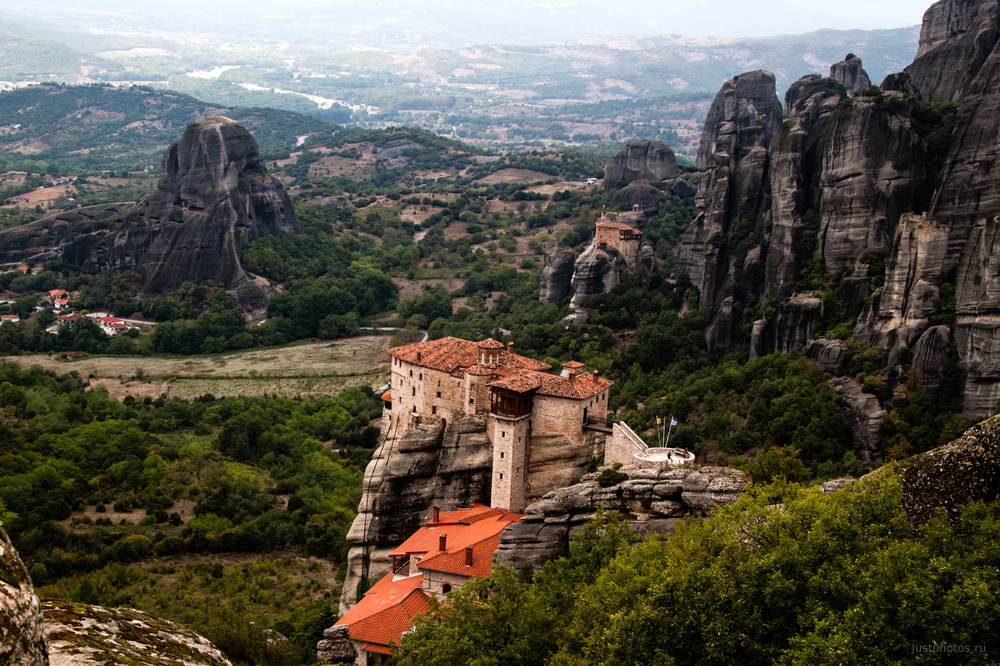
How the monasteries got there:
Monks first inhabited caves in these rocks around 1000 AD, seeking isolation for prayer. By the 1300s, they started building actual monasteries on top of the pillars to escape Ottoman invasions. Supplies were hauled up in nets. Monks climbed using removable ladders. The rope was replaced, they said, “when the Lord let it break.”
What you’ll see:
Most day tours visit 2-3 monasteries (you can’t physically visit all six in one day). Each requires climbing stairs, respecting dress codes (shoulders and knees covered—they provide wraps), and paying €3 entrance.
- Great Meteoron: The largest and highest monastery (613m elevation), founded 1356. Houses museum with manuscripts, icons, and monastic artifacts.
- Varlaam: Second-largest, incredible frescoes, barrel system still visible (they used barrels to haul water up).
- Holy Trinity: Most difficult to reach (140 steps), featured in James Bond “For Your Eyes Only” film, maybe the most dramatic setting.
- St. Stephen’s: Easiest access (just a bridge, minimal stairs), women’s convent, beautiful views.
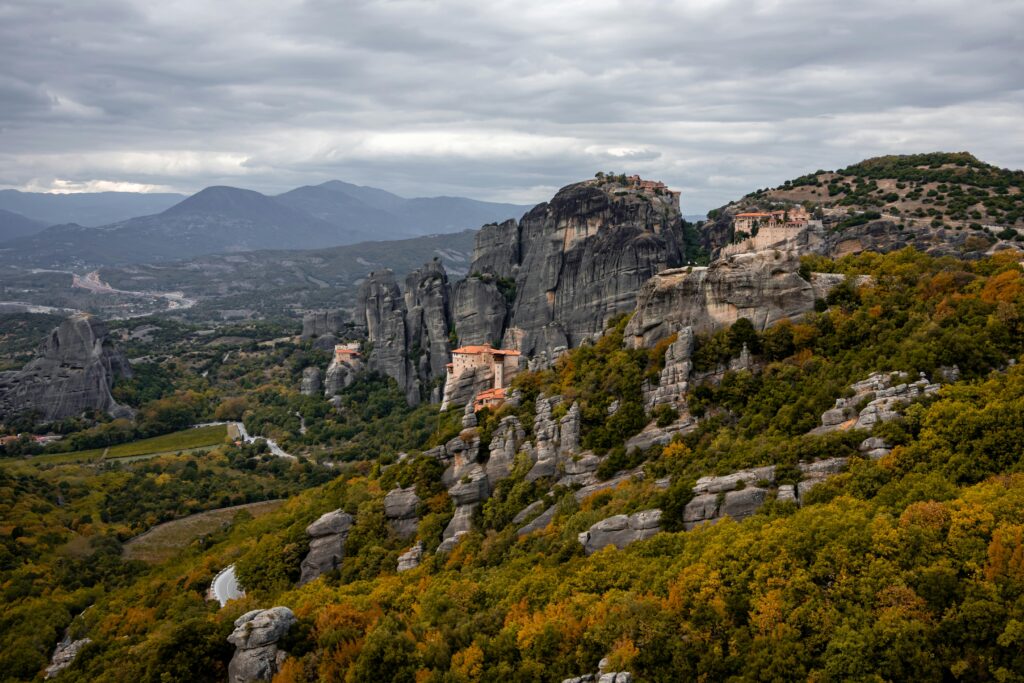
The journey itself:
Most organized tours from Athens follow this schedule:
- 7-8am: Hotel pickup in Athens
- 12pm: Arrive Kalambaka/Kastraki villages (base of Meteora)
- 12:30-5pm: Visit 2-3 monasteries, lunch break, photo stops
- 5:30pm: Depart back to Athens
- 8-9pm: Arrive back Athens
The drive crosses central Greece through mountains and plains. It’s scenic but long. Bring entertainment (podcast, book, music). Tour buses usually show Greek movies or documentaries during the drive.
Practical details:
- Tours: €80-120 including transport, English guide, monastery entrances
- €3 per monastery entrance (pay separately)
- Lunch: €15-20 per person at Kalambaka restaurants
- Dress code enforced: Covered shoulders and knees (wraps provided)
Should you actually do it as a day trip?
Do it if:
- You have at least 5-7 days total in Athens/Greece
- You love dramatic landscapes and can handle long bus rides
- You don’t plan to return to Greece anytime soon
- Byzantine history and Orthodox monasteries interest you
Skip it if:
- You have limited Athens time (3-4 days or less)
- You hate long bus journeys
- You’d rather spend full days at destinations than transit
- You can visit Meteora separately on a future trip
My experience: I did Meteora as a day trip my second time in Greece. No regrets—it’s breathtaking. But I was exhausted by the end. If you can spare two days, drive yourself or take the train to Kalambaka, stay overnight, watch sunset and sunrise (the rocks glow), visit 4-5 monasteries without rushing. That’s the better way.
Alternative for day trips from Athens: Sunset at Cape Sounion provides dramatic clifftop views in 3 hours total. Delphi offers ancient sites with mountain scenery in half the travel time. Both are more manageable as actual day trips.
Mount Parnassus: Sacred Mountain of Apollo and the Muses
- Distance: 180-200 km northwest (2.5-3 hours)
- Why go: Hiking, mountain villages, winter skiing, combines with Delphi
- Time needed: Half day (with Delphi) or full day (hiking focus)
Most visitors know Mount Parnassus as the dramatic backdrop to Delphi. But the mountain itself—sacred to Apollo and the Muses in Greek mythology—offers completely different experiences depending on when you visit.
At 2,457 meters elevation, Parnassus dominates central Greece. Ancient Greeks believed the Muses lived here, inspiring artists, poets, and musicians. The mountain’s biodiversity earned it national park status in 1938.
Summer mountain activities:
- Hiking trails wind through alpine meadows, pine forests, and rocky peaks. Routes range from easy walks to serious mountain climbs. The most popular trail starts from the village of Tithorea and climbs to the main peaks (8-10 hours round trip, requires fitness and preparation).
- Corycian Cave: This massive limestone cavern was sacred to the Muses and nymphs. Ancient Greeks held rituals here. The cave measures 60 meters wide and 20 meters high. Located at 1,370m elevation, accessible by car + short hike.
Mountain villages:
- Arachova: Picturesque town clinging to mountain slopes, famous for handwoven textiles, local cheese (formaella), and wine. Many visitors stop here for lunch when visiting Delphi. Narrow stone-paved streets, cozy tavernas, beautiful mountain views.
- Delphi village: Modern town near the ancient site. Limited charm but convenient base. Better restaurants than you’d expect for a small tourist village.
Winter transformation:
December through April, Parnassus becomes Greece’s premier ski destination. The Parnassus Ski Center operates two areas:
- Kellaria: Main center, 12 slopes, modern facilities
- Fterolakka: Smaller, better for beginners
It’s not the Alps or the Rockies, but for a day trip ski adventure from Athens, it works surprisingly well. Locals from Athens drive up on winter weekends for day skiing.
Ski trip logistics:
- Season: December-April (snow dependent)
- Day packages: €35-50 (lift ticket + equipment rental)
- Ski lessons: Available for beginners
- Drive time: 3 hours from Athens
- Organized tours: €90-130 including transport and equipment
Best combined trip: Visit Delphi archaeological site in the morning (2-3 hours), lunch in Arachova (incredible mountain views, try the formaella cheese), explore Arachova village or hike near Corycian Cave in the afternoon. Full day from Athens, way more interesting than just Delphi alone.
When to visit:
- Spring (April-May): Wildflowers bloom, snow caps peaks, perfect hiking weather
- Summer (June-August): Hot in valleys, pleasant at elevation, best for high-altitude hikes
- Fall (September-October): Comfortable temperatures, autumn colors, fewer tourists
- Winter (December-March): Snow sports, cozy mountain village atmosphere
Planning Your Day Trips: The Practical Stuff
Let’s talk logistics. Theory is nice, but you need to actually book transport, buy tickets, and get yourself places. Here’s how day trips from Athens Greece actually work in practice.
Transportation: Your Real Options Explained
KTEL Bus System
The KTEL intercity bus network is Greece’s backbone for regional travel. Modern air-conditioned buses connect Athens to basically everywhere mentioned in this guide.
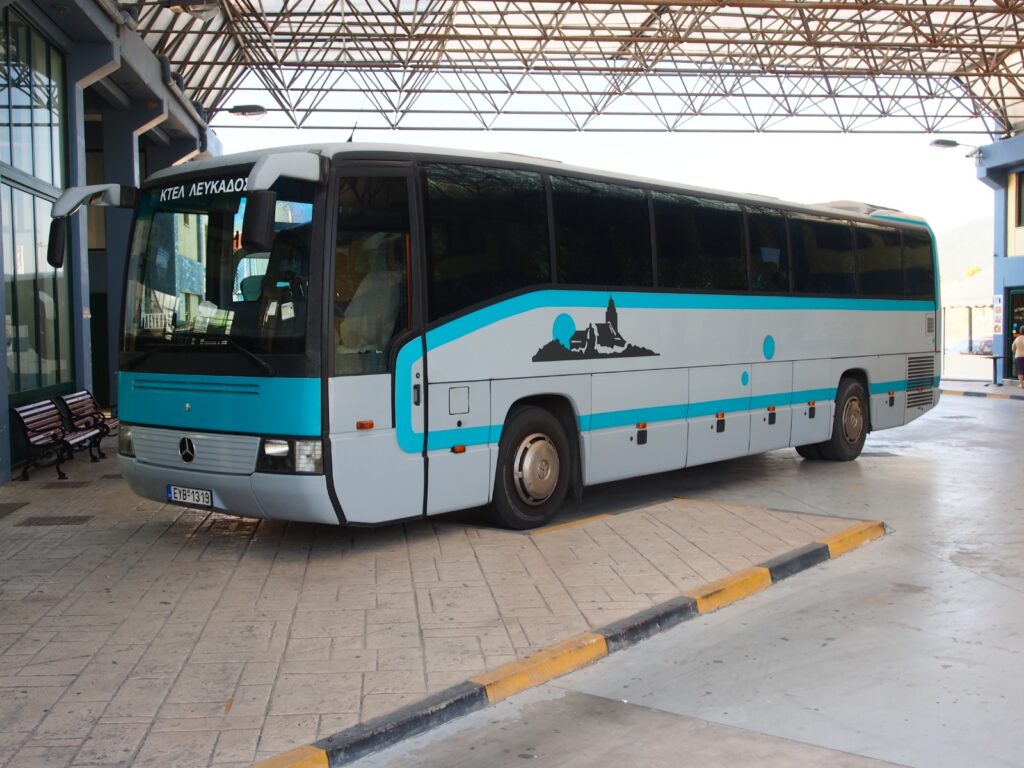
Two main terminals in Athens:
- Kifissos Terminal (Terminal A): Routes to Peloponnese – Nafplio, Mycenae, Corinth, Epidaurus
- Liossion Terminal (Terminal B): Routes to Delphi, Meteora, central Greece
How it works:
- Buy tickets at the terminal (cash or card)
- Tickets show bus number, platform, departure time
- Buses usually leave on time (within 10-15 minutes)
- Comfortable seats, AC, some have WiFi
- Most drivers speak basic English
- Costs: €7-25 one way depending on distance
- Pros: Cheap, reliable, comfortable, no driving stress
- Cons: Fixed schedules limit flexibility, can’t stop at random viewpoints, sometimes buses fill up (buy tickets in advance for popular routes/times)
Ferry Travel to Islands
All ferries to Saronic Gulf islands depart from Piraeus Port, accessible via Metro Line 1 (green line) from central Athens (40 minutes, €1.40).
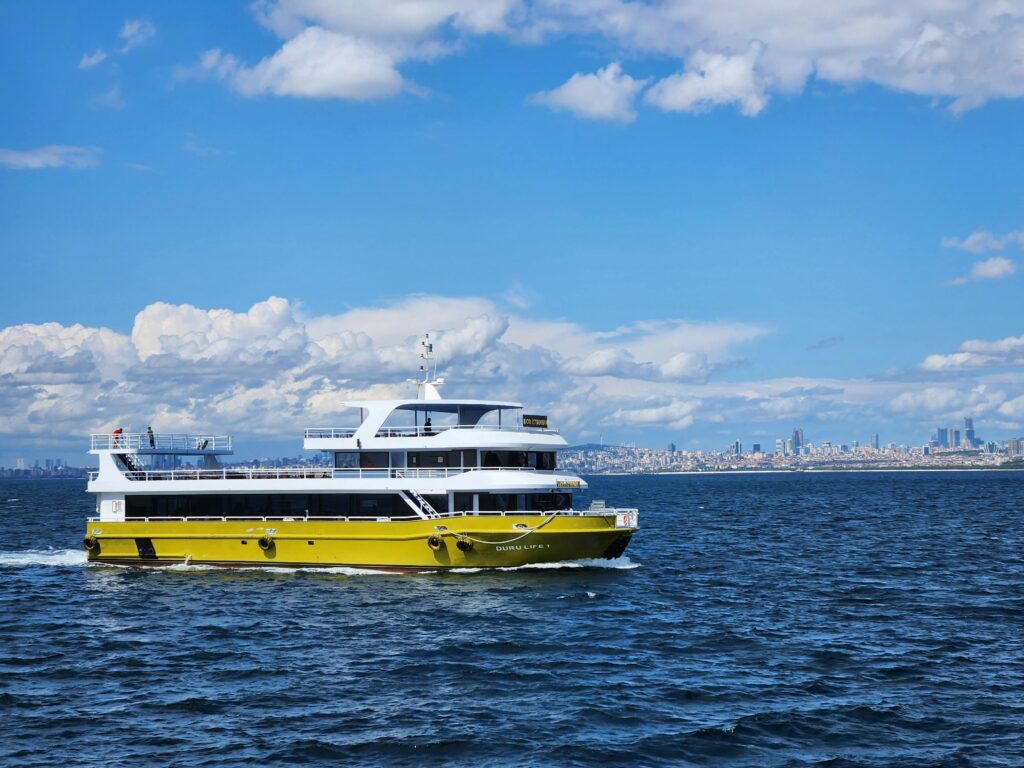
Ferry types:
- Regular ferries: Slower (1.5-2.5 hours), cheaper (€8-15), more comfortable, can walk around
- Flying Dolphins/Cats: Fast hydrofoils (40min-1 hour), pricier (€14-30), less comfortable, stay seated
Main companies:
- Blue Star Ferries: Most routes, reliable
- Hellenic Seaways: High-speed options
- Saronic Ferries: Local routes
Booking: Ferryhopper.com or GreekFerries.gr show all options and allow online booking. Book summer weekend ferries in advance—they sell out. Weekday trips usually have availability day-of.
Pro tips:
- Morning ferries (8-9am) less crowded than afternoon returns
- Sit outside deck on regular ferries (inside can get stuffy)
- Bring motion sickness medicine if prone to seasickness
- Check weather—rough seas = delays or cancellations
Organized Tours
Yes, they cost 2-3x more than doing it yourself. But tours solve multiple logistical headaches simultaneously:
What you get:
- Hotel pickup/dropoff (no navigating to bus terminals at 7am)
- English-speaking guide providing context
- Optimized routes visiting multiple sites efficiently
- Guaranteed transportation back (no missing the last bus)
- Often includes lunch or entrance fees
- Usually smaller groups (8-25 people)
Reputable companies:
- GetYourGuide: Easy booking, customer reviews, refund policies
- Viator: Part of TripAdvisor, vetted operators
- Key Tours Greece: Local company, excellent reputation
- CHAT Tours: Budget-friendly large group tours
When tours make sense:
- Complex multi-site days (Mycenae-Epidaurus-Nafplio)
- Far destinations (Meteora)
- First time in Greece (learning context enhances experience)
- Solo travelers (cost per person comparable to taxi/rental)
- Anyone who hates logistics stress
When to skip tours:
- Simple single-destination trips (Cape Sounion, Aegina)
- You want flexibility and spontaneity
- You hate being on someone else’s schedule
- Group dynamics stress you out
Rental Cars
Freedom to explore at your own pace, stop at viewpoints, visit multiple places on your timeline.

Requirements:
- International Driving Permit (IDP) plus your license
- 21+ years old (some companies require 23+)
- Credit card for deposit
Costs: €30-60/day including insurance. Book online in advance for better rates.
Companies: Avis, Hertz, Enterprise, and local Greek companies all operate from Athens airport and downtown locations.
What to know:
- Athens traffic is chaotic, aggressive, and stressful
- Parking in Athens is difficult and expensive
- Highway tolls exist (keep cash ready)
- Speed cameras are common
- Many archaeological sites have limited nearby parking
- Manual transmission is standard (automatic costs more)
Best for: Couples or small groups splitting costs, experienced drivers comfortable with European traffic, coastal route explorations (Athens Riviera to Sounion)
My personal recommendation matrix:
- Use buses for: Ancient Corinth, Delphi (if comfortable with bus travel)
- Use ferries for: All island trips (Aegina, Hydra, Poros, Agistri)
- Book tours for: Meteora, Mycenae-Epidaurus-Nafplio combination, first-time visitors wanting context
- Rent car for: Athens Riviera and Cape Sounion coastal drive, Nafplio with Peloponnese exploration, if you’re confident driving in Greece
Budget Breakdown: What Things Actually Cost
Let me give you realistic numbers for Athens day trips across different budget levels.
Budget-Conscious Traveler (€20-40/day):
- Bus to Ancient Corinth: €14 round trip
- Site entrance: €8
- Packed lunch from supermarket: €5-8
- Snacks and water: €3-5
- Total: €30-35
Mid-Range Comfort (€60-100/day):
- Island ferry (Hydra): €56 round trip (fast boat)
- Lunch taverna: €20-25
- Site entrance: €12
- Water taxi or rental: €15
- Coffee and snacks: €8
- Total: €90-110
Comfortable with Tours (€100-150/day):
- Organized Delphi tour with lunch: €60-75
- Extra site visit independently: €12
- Nice dinner back in Athens: €30-40
- Drinks and extras: €15-20
- Total: €117-147
Mini-Luxury Experience (€200+/day):
- Private Meteora tour: €180-250
- Lunch at premium restaurant: €40-60
- Extra activities: €30-50
- Total: €250-360
Money-saving strategies that actually work:
- Buy picnic supplies: Supermarkets sell fresh bread, cheese, tomatoes, olives for fraction of restaurant costs. Pack lunches for archaeological sites.
- Travel midweek: Tours cost 20-30% less Tuesday-Thursday versus Friday-Sunday. Ferries and hotels cheaper too.
- First Sunday monthly: Many sites offer free entrance November through March. Not summer unfortunately.
- Combine destinations: One rental car day visiting multiple Peloponnese sites beats three separate bus trips financially.
- Book ferries online in advance: Sometimes small discounts available versus port ticket office.
- Split costs: Traveling with 2-3 people? Rental car/taxi often cheaper than multiple bus or tour tickets.
- Eat where locals eat: Walk three blocks away from main tourist areas, prices drop 30-40%.
Timing Your Visits: Best Seasons and Times
Spring (April to early June):
✅ Advantages:
- Perfect temperatures (18-25°C)
- Wildflowers blooming across archaeological sites
- Fewer crowds at popular destinations
- Lower accommodation costs
- Clear skies for photography
- Comfortable for hiking and walking tours
❌ Disadvantages:
- Some island ferry routes limited (ramp up by May)
- Occasional rain (especially April)
- Shorter days for sunset visits
- Sea still cold for swimming in April
This is my favorite season for day trips from Athens Greece. The weather makes exploring ancient sites actually pleasant instead of exhausting.
Summer (June-August):
✅ Advantages:
- All ferry routes fully operational
- Guaranteed beach weather
- Extended site opening hours
- Festival season (concerts, performances)
- Most tours running
- Vibrant island atmosphere
❌ Disadvantages:
- Intense heat at archaeological sites (35-42°C)
- Peak crowds everywhere
- Highest prices all around
- Athens heat exhausting for early morning starts
- Midday becomes unbearable for outdoor activities
Summer strategy: Start at dawn. Visit sites 8-11am. Beach/swim/rest midday. Resume exploring 5-8pm. Many sites stay open until 8pm in summer specifically because midday is brutal.
Fall (September-October):
✅ Advantages:
- Still warm enough for swimming (September)
- Crowds diminishing rapidly
- Comfortable temperatures for sites
- Lower prices than summer
- Beautiful light for photography
- Locals friendlier (tourism stress reducing)
❌ Disadvantages:
- Ferry schedules start reducing (October)
- Some seasonal businesses closing
- Occasional autumn storms
- Sea temperature dropping (still fine September)
September is nearly perfect. You get summer weather without summer crowds or prices.
Winter (November-March):
✅ Advantages:
- Lowest prices (50% off summer rates)
- Empty archaeological sites
- Authentic local experience
- Cozy mountain village atmosphere
- Skiing at Mount Parnassus
❌ Disadvantages:
- Significantly limited island ferry schedules
- Shorter daylight hours
- Unpredictable weather (rain, occasional cold)
- Some sites reduced hours
- Beach activities impossible
- Some seasonal hotels/restaurants closed
Winter works if: You’re primarily interested in ancient sites and mainland destinations, don’t need beach time, appreciate empty tourist sites, have flexible plans for weather changes.
What to Actually Book in Advance
Must book ahead:
- Summer weekend ferries (especially July-August)
- Meteora day tours (popular, limited seats)
- Epidaurus Ancient Theater summer performances
- Car rentals in peak season (better rates + guaranteed availability)
- Nafplio hotels on summer weekends
Can book last-minute:
- Most KTEL bus tickets (buy at station)
- Winter island ferries (plenty of space)
- Archaeological site entries (except special exhibitions)
- Weekday tours (usually available)
- Most restaurant reservations except high-end places
Flexible planning wins: Greek weather changes quickly. That perfect Cape Sounion sunset? Clouds ruin it. Keep 1-2 days unplanned so you can choose destinations based on weather forecasts and energy levels.
Ready-Made Itineraries for Day trips from Athens
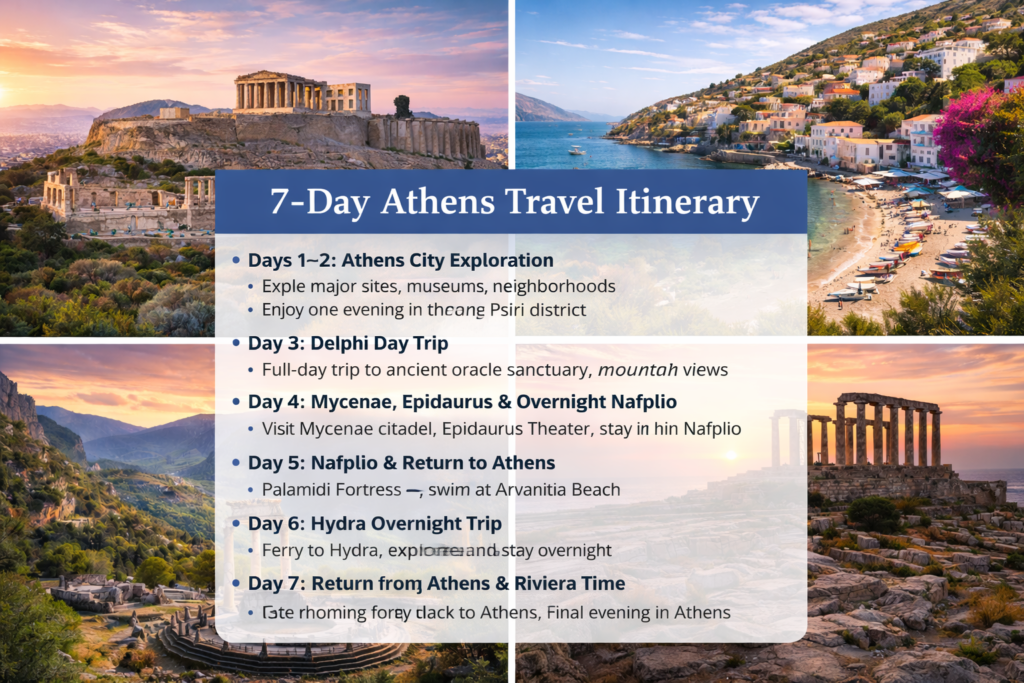
Let’s get practical. Here are actual itineraries I’ve tested that work well for different types of travelers doing day trips from Athens.
Week-Long Athens Base (7 Days)
Goal: Comprehensive exploration while maintaining Athens as home base
Day 1-2: Athens thorough exploration
- Major sites, museums, neighborhoods
- One evening in vibrant Psiri district
Day 3: Delphi Full Day
- Organized tour or independent bus trip
- Oracle sanctuary, museum, mountain scenery
- Lunch in Arachova
Fouth Day 4: Mycenae + Epidaurus + Overnight Nafplio
- Morning: Mycenae citadel and museum
- Afternoon: Epidaurus theater
- Evening: Check into Nafplio hotel
- Dinner at harbor taverna
Day 5: Nafplio Exploration + Return via Corinth
- Morning: Palamidi fortress climb, old town wandering
- Afternoon: Swim at Arvanitia beach
- Return to Athens stopping at Corinth Canal
- Back Athens by early evening
Day 6: Hydra Overnight Trip
- Morning ferry to Hydra
- Day exploring the car-free island
- Overnight in Hydra (experience after tourists leave)
- Evening: Quiet harbor atmosphere
7: Return from Hydra + Athens Riviera
- Late morning ferry back to Athens
- Afternoon: Vouliagmeni Lake thermal spa
- Final evening in Athens
Why this works: Includes two overnights outside Athens (breaking up routine), covers major destinations, allows deeper experiences rather than rushed day trips.
Money-Saving Tips & Local Secrets
After multiple trips testing different Athens day trips approaches, here’s the practical wisdom I wish I’d known from the start.
Hidden Gems Most Tourists Miss
Ancient Theatre of Thorikos
30 minutes from Athens, this Bronze Age theater (oldest in Greece) sits completely empty. Free entrance, incredible history, zero crowds. Near Lavrio port—combine with Cape Sounion trip.
Schinias Beach (Marathon)
40km from Athens, this long sandy beach sees mostly Greek families. The Marathon archaeological site and burial mound are nearby. Take KTEL bus from Pedion Areos terminal (€4.30 one way).
Loutraki Thermal Baths
Past Corinth, natural hot springs with spa facilities. Entry €8-12, way cheaper than Vouliagmeni and less touristy. Combine with Corinth Canal visit.
Kythnos Island
Further than Saronic Gulf islands (2.5 hours ferry) but still doable as long day trip. Barely any tourists, dozens of beaches, thermal springs, authentic village life. Most underrated island near Athens.
Temple of Artemis at Brauron
30 minutes east of Athens, important ancient sanctuary where young girls performed rituals for Artemis. Small site, excellent museum, almost no visitors. €4 entrance.
Timing Tricks That Save Money and Stress
- Archaeological sites: First hour after opening (8am summer, 8:30am winter) = empty sites, cool temperatures, golden morning light for photos. Last hour before closing also works but light gets harsh.
- Island ferries: Morning departures (8-9am) less crowded than afternoon returns (5-7pm). Everyone does islands as day trips, creating predictable patterns.
- Cape Sounion sunset: Everyone goes for sunset (crowded). Go for sunrise instead (5:30-6am arrival)—you’ll have the temple completely alone. Seriously magical.
- Delphi midweek: Tuesdays and Wednesdays see fewer tour buses than Monday/Thursday/Friday. Better site experience, easier parking.
- Nafplio weekends: Athenians flood Nafplio Friday-Sunday. Visit Monday-Thursday for half the crowds, easier restaurant reservations, better hotel rates.
Where Locals Actually Eat
Most tourist restaurants near major sites serve mediocre food at high prices. Locals eat elsewhere.
- Delphi area: Taverna Vakhos in Delphi town (try lamb kleftiko cooked in the traditional way). On the main street but locals fill it.
- Nafplio: Alaloum (old town, reservations essential, amazing meze selection). Pidalio Mezedopoleio at the harbor (seafood, reasonable prices, locals’ choice).
- Hydra: Xeri Elia taverna up from the harbor (family recipes, grandmother cooking, find it on the path toward the monasteries).
- Aegina: Nontas restaurant (best seafood on the island, back from the harbor). Locals recommended it to me, now I recommend it to everyone.
- Ancient Corinth:To Archontiko café (excellent traditional breakfast before site visit).
General rule: If menu has photos, keep walking. If you see families with children and older Greeks, that’s your signal.
Food and Shopping Wisdom
- Aegina pistachios: Buy from harbor vendors who roast them fresh, not packaged versions from tourist shops. Fresh roasted cost half the price and taste infinitely better. €10-15 for a good bag.
- Market strategy: Every Greek town has a weekly laiki agora (street market). Fresh produce, olives, cheese for picnics at unbeatable prices. Ask your hotel when/where the local market happens.
- Water bottles: Archaeological sites charge €2-3 for water. Bring reusable bottle, fill at hotels/cafés. Save €10-15 per day.
- Afternoon prices: Many tavernas offer different pricing lunch versus dinner. Same food, 20-30% cheaper at lunch (2-4pm).
Photography Gold
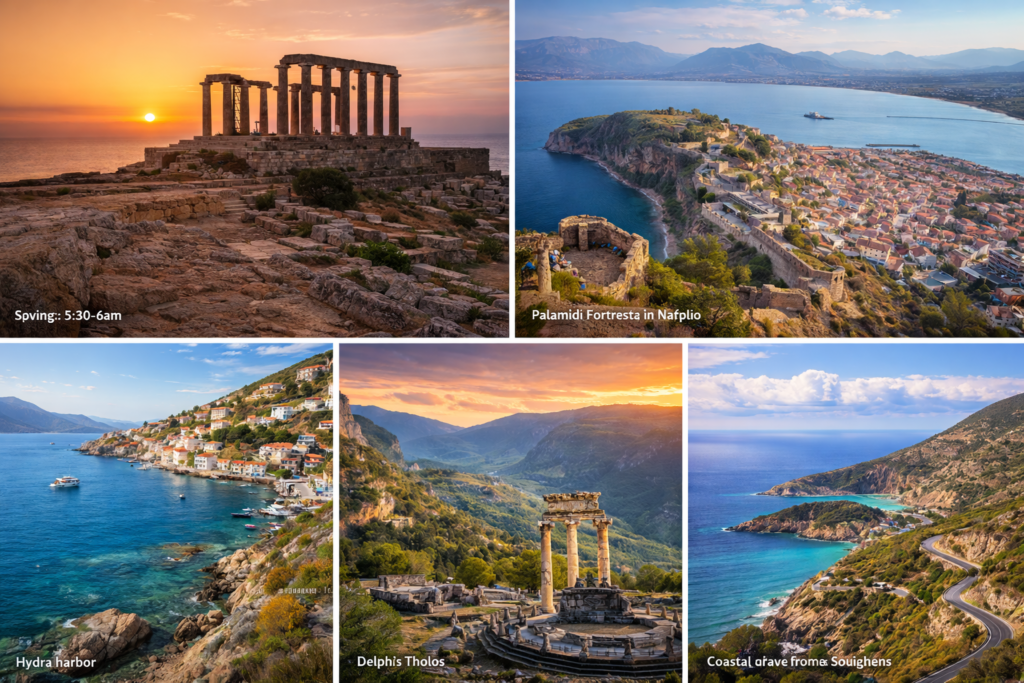
- Best sunrise location: Temple of Poseidon at Cape Sounion (arrive 5:30-6am)
- Best panorama: Palamidi Fortress in Nafplio (climb morning before heat)
- Best island shot: Hydra harbor from the coastal path to Kamini village
- Best mountain view: Delphi’s Tholos with valley behind (shoot mid-morning when sun lights the valley)
- Best coastal drive: Athens to Sounion via Vouliagmeni (stop at every scenic viewpoint—there are dozens)
- Drone warning: Flying drones near archaeological sites is ILLEGAL. Heavy fines. Don’t do it. Guards will confiscate drones and fine you €500+.
What to Pack for Day Trips
Essential day trip bag:
- Reusable water bottle (sites are hot, water is expensive)
- Sunscreen SPF 50+ (Greek sun is no joke)
- Wide-brim hat
- Comfortable walking shoes (not flip-flops for sites)
- Light cardigan (ferry AC, monastery dress codes)
- Power bank (your phone will die from photos)
- Small first aid kit (blisters from cobblestones)
- Tissues/toilet paper (site bathrooms are basic)
- Light snacks (energy bars, fruit)
- Cash (small villages, many places don’t take cards)
What NOT to pack:
- Heavy camera gear (your phone takes excellent photos)
- Excessive clothing changes
- Guidebooks (this article has you covered)
- Laptop or work stuff (you’re on vacation)
Final Thoughts: Making the Most of Day Trips from Athens Greece
After spending months exploring day trips from Athens Greece across multiple visits, testing every transportation option, eating at dozens of tavernas, and occasionally getting completely lost, here’s what I’ve learned:
Athens isn’t just another city to visit and leave. It’s your strategic base for accessing extraordinary diversity—ancient sanctuaries in mountains, Byzantine monasteries on rock pillars, car-free islands in turquoise water, Venetian towns with fortress views, thermal lakes, and sunset temples on seaside cliffs. All within two hours of your hotel.
The real magic happens when you stop trying to see everything and start experiencing places properly. Spend a full day at Delphi instead of rushing through. Stay overnight in Nafplio to feel the town after tour buses leave. Take the slow ferry to Hydra and watch the islands drift past. Arrive at Cape Sounion an hour before sunset and watch the temple glow as light changes.
Greece rewards travelers who slow down enough to feel it. The warmth of ancient stones in afternoon sun. The taste of fresh octopus caught that morning. The sound of bells drifting across valleys from hillside chapels. These moments happen between destinations, not just at them.
My honest recommendations:
- If you have 3-4 days: Choose 2-3 trips maximum. Do them properly. Maybe Delphi, one island, and Cape Sounion sunset. Quality over quantity.
- If you have a week: Mix ancient sites, islands, and coastal experiences. Delphi, Mycenae-Epidaurus-Nafplio, Hydra, Athens Riviera, and keep one day flexible.
- Whatever your timeline: Pack comfortable shoes, bring water, use sunscreen religiously, leave room for spontaneity, talk to locals, eat where Greeks eat, and remember that sometimes the best moments are the unplanned ones.
Safe travels, and don’t forget to look up from your camera occasionally—some views are meant to be remembered rather than just photographed.